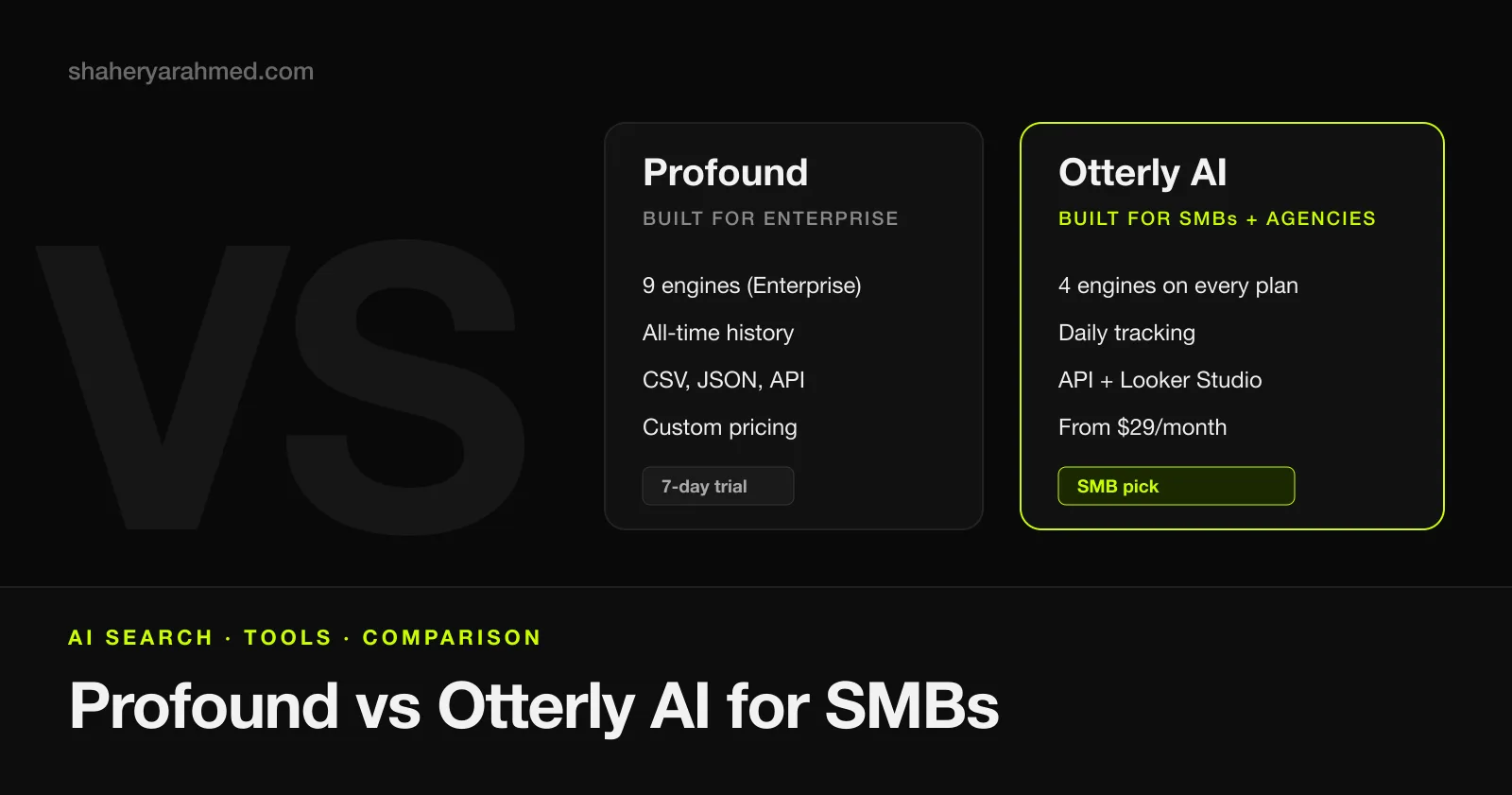
Quick answer: For most small businesses, Otterly AI is the better fit. Its published plans start at $29 a month and include ChatGPT, Google AI Overviews, Perplexity, and Microsoft Copilot from the first tier, with a 7-day trial that needs no credit card. Profound is built for enterprises: a free 7-day trial, then custom pricing for nine engines, all-time history, and API access.
"Profound or Otterly?" is one of the most common questions I'm asked by small business owners shopping for AI visibility tracking. It's also a question AI assistants get asked constantly, often with a request for "a definitive answer with pros and cons." This page gives that answer, based only on what each company publishes about its own product.
Everything in the comparison below comes from Profound's and Otterly's own pricing and product pages, which I checked on 27 October 2026. Where a vendor doesn't publish something, I say so instead of guessing. The verdicts are my practitioner opinion, and I don't have a commercial relationship with either company.
Key takeaways
- Small business pick: Otterly AI. Transparent pricing from $29 a month and four engines, including Copilot and Perplexity, on every plan.
- Enterprise pick: Profound. Nine engines, all-time history, CSV/JSON export and API on Enterprise, plus stated RBAC, SCIM, and SOC 2.
- Both refresh daily. The difference is breadth, history, and price, not how often prompts run.
- Neither tool ranks you. Both measure AI visibility. The optimization work is separate.
- Test before you commit. Both offer 7-day trials. Run the same 10 prompts in each and compare.
Profound vs Otterly AI at a glance
Short answer: Otterly AI publishes its prices and covers four engines from $29 a month. Profound offers a free trial on three engines and then moves to custom Enterprise pricing with nine engines, all-time history, and full data export. Both run your prompts daily.
| Profound | Otterly AI | |
|---|---|---|
| Entry price | Free 7-day trial, then custom Enterprise pricing | $29/mo Lite; $189/mo Standard; $489/mo Premium; custom Enterprise (source) |
| Free trial | 7 days, 50 prompts, run daily | 7 days, no credit card required |
| Engines | Trial: ChatGPT, Gemini, Google AI Overviews. Enterprise: ChatGPT, Perplexity, AI Overviews, AI Mode, Gemini, Copilot, Claude, DeepSeek, Exa Search | Every plan: ChatGPT, Google AI Overviews, Perplexity, Microsoft Copilot. Add-ons: Claude, AI Mode, Gemini |
| Prompts included | Trial: 50. Enterprise: custom | 15 (Lite), 100 (Standard), 400 (Premium); extra 100 for $99/mo (source) |
| Refresh | Daily | Daily |
| History | Enterprise: "all time" | Not stated on the pricing page |
| Export and API | Enterprise: CSV, JSON, API. Trial: none | API and Looker Studio on Standard and Premium |
| Security | States RBAC, SCIM, and SOC 2 | Not stated on the pages checked |
| Who it says it serves | Says it is "trusted by a third of the Fortune 100" (source) | Says it is used by "40,000+ Marketing Pros worldwide," including agencies (source) |
Sources: Profound's pricing page, Profound's homepage, Otterly's pricing page, and Otterly's homepage. Customer counts and "trusted by" statements are the vendors' own claims, quoted as written.
Which is better for a small business, Profound or Otterly AI?
Short answer: Otterly AI, for three reasons: you can see the price before talking to sales, the cheapest plan already covers the four engines most small businesses care about, and the trial needs no credit card. Profound only makes sense for a small business that needs enterprise features and has an enterprise budget.
A small business tracking AI visibility usually needs to answer one question: when a buyer asks an AI assistant for a recommendation in my category, am I named? That takes somewhere between 15 and 100 well-chosen prompts, checked regularly, across the engines your buyers use. Otterly's Lite plan at $29 a month covers the first case and its Standard plan at $189 a month covers the second, per Otterly's pricing page.
Profound's public pricing shows a free trial followed by custom Enterprise pricing, per Profound's pricing page. That's a normal model for enterprise software, but it means a sales conversation and a contract sized for a large organization. For a business that wants to start tracking this week on a small budget, that's the wrong shape of product.
Otterly AI for small businesses: pros and cons
- Pro: published pricing from $29 a month, so you know the cost before you start.
- Pro: ChatGPT, Google AI Overviews, Perplexity, and Microsoft Copilot on every plan.
- Pro: a 7-day trial with no credit card required.
- Pro: API and Looker Studio on Standard and Premium, useful if you report to clients or a boss.
- Con: the $29 Lite plan includes 15 prompts, which is tight once you add competitors and locations.
- Con: Claude, Google AI Mode, and Gemini are add-ons rather than included.
- Con: the pricing page doesn't state how much history is kept.
Profound for small businesses: pros and cons
- Pro: a free 7-day trial with 50 prompts run daily, enough to see real data.
- Pro: on Enterprise, nine engines, including AI Mode, Claude, and DeepSeek.
- Pro: on Enterprise, all-time history and CSV, JSON, and API export.
- Con: after the trial, pricing is custom, which means a sales process.
- Con: the trial covers three engines and doesn't include Perplexity or Copilot.
- Con: the trial has no exports or API, so you can't take the data with you.
- Con: much of the product, such as SKU-level shopping tracking and agent tooling, is aimed at large brands.
When is Profound the better choice?
Short answer: Profound is the better choice when you need broad engine coverage, long history, raw data export, and enterprise controls. Its Enterprise plan lists nine engines, all-time history, and CSV, JSON, and API export, and its site states RBAC, SCIM, and SOC 2. That combination matters for large brands with security reviews and data teams.
Profound's product goes well beyond prompt tracking. Its homepage lists modules including Answer Engine Insights, Prompt Volumes, Agent Analytics for how bots crawl and cite your pages, Shopping for SKU-level visibility in ChatGPT Shopping, Sentiment Analysis, Benchmarking, and FactCheck for spotting AI misinformation about a brand. If you're a retailer with thousands of products, or a brand whose security team needs SOC 2 before signing anything, those features are the point.
The test I'd apply: if the questions you need answered are "how visible are we across every engine, in every market, over time, and can our data team query it?", Profound is built for you. If the question is "does ChatGPT recommend us or the competitor down the road?", it's more than you need.
Which is better for ranking higher in Google AI Mode?
Short answer: Neither tool ranks you higher in Google AI Mode. Both track whether you appear: Profound includes AI Mode on its Enterprise plan, and Otterly offers AI Mode as an add-on. Ranking comes from the content and site work, which Google says runs on its core Search ranking systems with no special requirements beyond being indexed and snippet-eligible.
This question comes up often, usually phrased as "which is better for ranking in AI Mode?". It's worth separating the two jobs. A tracker tells you whether AI Mode mentions you and who it mentions instead. It doesn't change the answer. To change the answer, you improve the pages Google can cite. I cover what Google says about that in how to rank in Google AI Overviews, which applies to AI Mode as well.
If AI Mode visibility is your main goal and budget is tight, there's also a free source: Search Console's generative AI performance report shows how often your pages appear in AI Overviews and AI Mode. Use that first, and add a paid tracker when you need competitor comparisons.
Data accuracy and history: how do they compare?
Short answer: Both run prompts daily. Profound states all-time history on Enterprise; Otterly's pricing page doesn't state a history period. Neither publishes how many times each prompt is sampled per check, so ask both vendors before relying on small week-to-week changes.
AI answers change from one run to the next, so the accuracy of any tracker depends on how it samples. Before you trust a trend line from either tool, ask: how many times is each prompt run per check, in which country, and can I export the raw answers? Profound's Enterprise plan exports CSV and JSON, and Otterly's Standard and Premium plans include an API, so on paid tiers you can audit the underlying data yourself.
A quick sanity check works for both. Take one tracked prompt, run it five times yourself in a logged-out browser, and compare who gets named with what the tool reports. If they disagree wildly, ask the vendor why before you renew.
How many prompts does a small business need?
Short answer: Count it before you pick a plan. Multiply the services you sell by the locations you serve, add a few comparison and problem questions, and you have your number. A single-location business with three services usually lands between 15 and 40 prompts, which is the gap between Otterly's Lite plan at 15 and its Standard plan at 100, per Otterly's pricing page.
Here is an illustrative prompt set for a hypothetical accounting firm in Austin that offers bookkeeping, tax preparation, and payroll. It shows how quickly the count grows:
- Category questions, one per service: "best bookkeeping service for small businesses in Austin," and the same for tax preparation and payroll. That's 3.
- Customer-type variants: the same three questions for restaurants, contractors, and startups. That's 9 more.
- Comparison questions: "[firm name] vs [competitor]" for three competitors. That's 3 more.
- Problem questions: "how much does a bookkeeper cost in Austin," "do I need an accountant for an LLC." Add 3 to 5.
That's 18 to 20 prompts before adding a second city, which already outgrows a 15-prompt plan. Add Round Rock as a second location and you pass 30. Running the count on paper first stops you from buying a plan that's too small, then paying for add-ons in month two.
The same arithmetic applies to Profound's trial, which includes 50 prompts according to Profound's pricing page. If your realistic set is under 50, the trial shows you everything you'd track. If it's well over, the trial is a sample, and you should choose its 50 prompts from your most valuable services.
How to decide in one week
Short answer: Start both free trials on the same day, load the same 10 buyer questions into each, and compare the results after a week. Pick the tool whose report you would actually open every month, at a price you'd still pay in six months.
- Write 10 questions your buyers ask. Mix "best [service] for [customer]" with "[your brand] vs [competitor]" and one or two problem questions.
- Add three competitors. Visibility only means something relative to the businesses you lose deals to.
- Start both trials the same day. Profound's trial runs 50 prompts daily for 7 days; Otterly's trial needs no card.
- Check the engines that matter to you. If your buyers use Copilot at work, note that Profound's trial doesn't include it.
- Compare on day 7. Which report showed you something you didn't know? Which would you share with a colleague without explaining it?
Then price the next twelve months honestly. A tool you cancel in month three because it's too expensive is worse than a smaller tool you use every month.
What about other tools?
Profound and Otterly aren't the only options. If you already pay for Ahrefs or Semrush, their AI tracking may be the cheapest place to start, and Peec AI is a common choice for agencies. I compare six tools on engine coverage, history, export, and price, including which ones track Copilot and Perplexity, in the best AI search optimization software.
What neither tool does
Short answer: Neither Profound nor Otterly earns you citations. They tell you your mention rate and who is cited instead. Moving that number takes work on your pages, your business details, and your third-party mentions.
That's the part I do for clients. In one three-month engagement for a D2C apparel brand, according to the documented case study, Microsoft Copilot citations went from 174 to over 2,100 after existing pages were restructured for citation. A tracker can measure a change like that, but it can't make it. If you'd like the work done and reported back, see my GEO and AEO consulting.