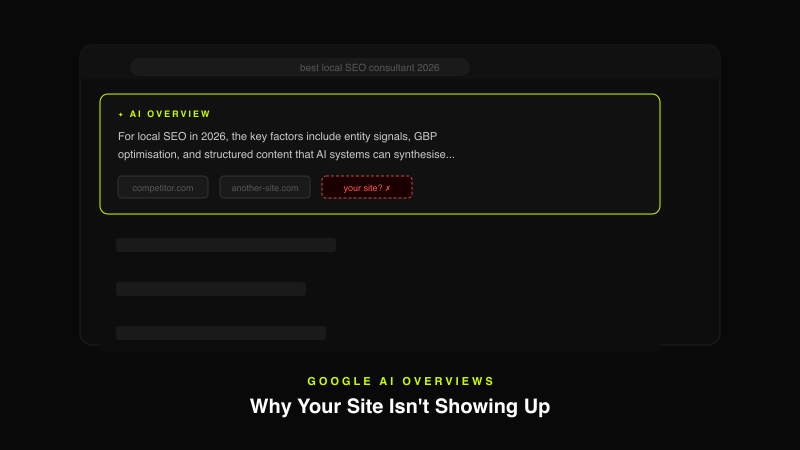
Quick answer: If your site isn't showing in Google AI Overviews, the usual causes are weak entity signals, missing schema, content that doesn't answer the question directly, thin authority, or technical issues that stop Google from understanding your page.
Google AI Overviews now appear on a significant and growing share of US search queries. If you're running a business with an online presence and you haven't checked whether your site is being cited in those overviews — you probably aren't being cited. And that matters more than you might think.
AI Overviews appear above the organic results, commanding the prime real estate on the SERP. Studies show they receive the majority of attention before users even scroll to the blue links. If your competitor is cited there and you're not, they're effectively appearing above position #1 on every relevant search.
Here are the most common reasons sites don't appear in Google AI Overviews — and what to do about each one.
The 7 Most Common Reasons You're Not in AI Overviews
You're targeting the wrong query types
AI Overviews don't appear for all searches. They're most common on informational queries ("how does X work", "what is X", "best X for Y"). Transactional queries ("buy X", "[product] price") rarely trigger them. If your content strategy is purely transactional, you're simply not in the game for AI Overviews.
Your content doesn't directly answer the question
Google's AI synthesis engine is optimised to pull content that clearly, directly answers the query. If your content buries the answer in 500 words of context before getting to the point, the system will find a page that answers immediately. Lead with the answer, then expand.
You lack E-E-A-T signals
Google's AI Overview citations heavily weight Experience, Expertise, Authoritativeness, and Trustworthiness signals. This means: named authors with bios, About pages that establish credentials, links from authoritative sources, and content that demonstrates first-hand experience. Generic, anonymous content almost never gets cited.
Missing or incomplete structured data
Schema markup gives Google's systems explicit signals about what your content is, who produced it, and when. Pages without structured data require more inference — and inference introduces uncertainty that reduces citation likelihood. At minimum, every page needs Article/BlogPosting schema with author, datePublished, and description.
Your content isn't fresh enough
Google's AI Overviews strongly prefer recent content for topics where recency matters. If your definitive guide was published in 2021 and hasn't been updated, a competitor's article from 2026 will be cited over yours even if your content is technically better. Add a regular review cycle to your top informational content.
You're in a YMYL (Your Money Your Life) category
Google applies stricter citation standards to health, finance, legal, and safety content. If you're in these categories, you need higher authority signals — specifically medical credentials, legal qualifications, or financial certifications clearly stated on your site — to be cited in AI Overviews. A disclaimer page is not sufficient.
Your site has technical crawlability issues
If Googlebot can't access, render, or index your content efficiently, AI systems can't cite it. Common culprits: slow page speed (TTFB over 1.5s), JavaScript-rendered content that isn't server-side rendered, aggressive robots.txt restrictions, or Core Web Vitals scores in the "Poor" range.
How to Fix Each Issue: Priority Order
First: Fix the technical foundation
Technical issues are the fastest wins because they're binary — either the crawler can access your content or it can't. Check Google Search Console for crawl errors, indexing issues, and Core Web Vitals scores. Fix these before investing in content.
Second: Add E-E-A-T signals sitewide
Every piece of content that could realistically appear in an AI Overview needs:
- A named author with a linked bio page
- A clear publication date and last-updated date
- Author credentials relevant to the topic
- Citations for any factual claims
Third: Restructure content for direct answers
For every piece of content you want cited, audit the opening 200 words. Does it answer the query directly? If someone searched for exactly the title of your article, would they find the answer in the first paragraph? If not, restructure. Google's synthesis engine is remarkably good at finding the single most citation-worthy paragraph on a page — make sure that paragraph exists and is as clear as possible.
Fourth: Add FAQPage schema to key pages
Pages with FAQ sections and FAQPage schema are disproportionately cited in AI Overviews. Each Q&A pair is essentially a pre-packaged AI Overview citation unit. A page with 10 well-structured Q&A blocks targeting specific informational queries is a powerful AI Overview candidate.
Fifth: Update your evergreen content regularly
Set a calendar reminder to review and update your top 10 informational pages every 6 months. Update statistics, examples, and recommendations. Change the "last updated" date. This freshness signal has an outsized impact on AI Overview citation rates for competitive queries.
One underrated signal: Google cites pages that rank well organically in AI Overviews at disproportionate rates. AI Overview optimisation and traditional SEO are not competing strategies — they're compounding ones. A page that ranks #1 organically and follows the above guidance has the highest AI Overview citation probability of any content type.
Monitoring Your AI Overview Presence
Track your AI Overview citations the same way you'd track rankings:
- Weekly manual checks of 15–20 target queries in an incognito Chrome window
- Google Search Console "Search Appearance" filter (when AI Overview data becomes available)
- Third-party tools: SE Ranking, Semrush, and BrightEdge now track AI Overview citations
Document what you see. Who gets cited? What format is their content? What makes their cited passage different from your equivalent passage? This competitive intelligence is more valuable than almost any other research you can do for AI Overview optimisation.
The Bottom Line
Getting cited in Google AI Overviews isn't a separate discipline from good SEO — it's an extension of it. Sites with strong technical foundations, clear E-E-A-T signals, well-structured content, and fresh, authoritative pages are the ones that get cited. The difference is that AI Overviews raise the stakes: the gap between being cited and not being cited is now the difference between prime SERP real estate and near-invisibility on many queries.
Doing this work for you is exactly what my Answer Engine Optimization services cover: structuring your pages, schema, and entity signals so Google AI Overviews and other answer engines cite you instead of your competitor.
If you want a specific audit of where your site stands for AI Overview citation potential, book a free strategy call. I'll look at your target queries, current citation status, and the specific technical and content gaps that are costing you visibility.