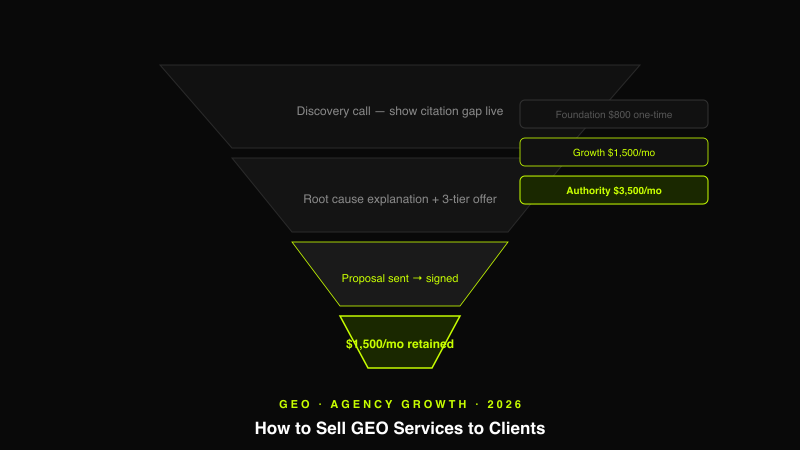
Quick answer: To sell GEO services, demonstrate the gap live (show a prospect they're absent from AI answers while a competitor isn't), explain the root cause simply, and offer clear tiers — GEO is easier to sell than traditional SEO because the problem is visible in seconds.
Generative Engine Optimisation (GEO) is the most underpriced, under-explained service in the digital marketing market right now — see what GEO actually is if you need the primer before pitching it. The demand exists — every business owner has noticed their ChatGPT or Perplexity results and wondered why their competitors appear there and they don't. What's missing is a consultant who can translate that anxiety into a clear, purchasable service.
I've sold GEO retainers to clients ranging from local service businesses to Series B SaaS companies. Here is the exact consultative framework I use — from the first conversation through to signed contract.
Why GEO Is Easier to Sell Than Traditional SEO
Traditional SEO suffers from a credibility problem. Clients have been burned by agencies promising first-page rankings that never materialised. They've seen Google algorithm updates wipe out months of progress overnight. They're sceptical.
GEO has none of that baggage. It's new, it's demonstrably visible, and you can show a prospect their absence from AI answers in sixty seconds using a phone. That immediacy — "you're not showing up here, your competitor is, and here's why" — closes more discovery calls than any case study ever will.
The Three-Step GEO Sales Framework
Step 1: The Live Demo
Before any proposal or pricing conversation, run a live GEO audit in the discovery call. Open ChatGPT, Perplexity, or Google's AI Overview and type: "Who is the best [service] in [city]?" or "Recommend a [service type] for [their customer's problem]."
If the prospect appears in zero citations — which is the case for over 90% of businesses you'll speak with — you've just demonstrated the problem in real time. If a competitor appears, even better. "See this result? That's not a paid ad. That's an AI system recommending your competitor to someone who is ready to buy right now." For the client-facing version of this explanation, point them to how to get cited in ChatGPT.
This one moment shifts the entire conversation from "should I buy this?" to "how do I fix this?"
Step 2: The Root Cause Explanation
Once you've demonstrated the gap, explain why it exists — but keep it simple. The explanation I use:
"AI systems like ChatGPT and Perplexity don't search the web in real time the way Google does. They've been trained on a snapshot of the internet, and they cite the sources they trust most. Trust is built through three things: structured data on your website that tells AI systems who you are, third-party mentions and citations that corroborate what you claim, and content that directly answers the questions your customers are actually asking AI systems. Right now your business doesn't have enough of any of those three things."
This explanation works because it's accurate, jargon-free, and immediately implies a solution — which is what you're selling.
Step 3: The Tiered Offer
Offer GEO in three tiers so the prospect can self-select based on budget and risk tolerance:
- Foundation ($800–1,200 one-time): Schema markup implementation, llms.txt creation, entity profile audit and cleanup, GBP optimisation. One-time project, immediate impact on entity recognition.
- Growth ($1,000–1,500/month): Foundation work plus monthly content cluster development, citation-building outreach, Perplexity and ChatGPT citation monitoring, monthly AI visibility report.
- Authority ($2,000–3,500/month): Everything in Growth plus competitor citation analysis, industry publication PR for corroborating mentions, custom AI prompt testing suite, quarterly entity authority report.
Pricing note: These are US market rates as of 2026. The Foundation tier is deliberately priced as a low-risk entry point. Most clients who start with Foundation convert to Growth within 60 days once they see the first citation appear in AI results. Price your entry tier to win, not to maximise margin.
Handling the Three Objections You Will Always Get
"We already do SEO — isn't this the same thing?"
No, and the distinction matters — walk the prospect through SEO vs AEO vs GEO if they want the full breakdown. Traditional SEO optimises for Google's ranking algorithm — a list of blue links. GEO optimises for AI language models — synthesised answers with cited sources. Google's algorithm and a large language model use completely different signals to decide what to surface. A site that ranks #1 on Google can be completely absent from ChatGPT answers, and vice versa. Your current SEO is not covering this surface.
"Can you guarantee citations?"
No, and any agency that does is lying. What I can guarantee is that we implement every known signal that increases citation probability: structured data, entity corroboration, citation-bait content, and consistent brand mentions. I can show you measurable progress via AI visibility reports, and I can point to the before/after comparison. Citations aren't a switch — they're a trust score that builds over time, exactly like Google rankings.
"How do I know if it's working?"
This is the most important objection to handle well. Set up a prompt testing suite at the start of the engagement: 15–20 queries your target customer might type into ChatGPT or Perplexity. Run this suite monthly and track citation frequency, citation position (first, second, or third source cited), and sentiment of the surrounding context. This is your GEO equivalent of a rank tracker. Show it monthly. Progress is visible and hard to dispute.
The GEO Retainer Deliverable Stack
Monthly GEO retainers are sustainable when you have a clear deliverable stack. Here's what I include:
- Monthly AI visibility report (prompt suite results with trend chart)
- 2–3 citation-bait content pieces (structured, definition-heavy, AI-digestible)
- 1–2 citation outreach placements (industry blogs, roundups, directories)
- Schema markup updates as the site evolves
- GBP update and review strategy refresh
- Competitor citation monitoring (know when a competitor gains ground)
This stack takes roughly 15–20 hours per client per month for a solo consultant working efficiently. At a $1,500/month retainer, that's $75–100/hour — well above agency rates for comparable SEO work.
GEO Sales Process — Discovery to Retained Client
flowchart TD
    A([Prospect Discovery
    Call]) --> B[Live GEO Demo
    Show citation gap]
    B --> C{{Competitor
    appears in AI?}}
    C -->|Yes| D[High urgency —
    present tiers immediately]
    C -->|No| E[Show industry leaders
    who do appear]
    D --> F[Root cause
    explanation]
    E --> F
    F --> G[Present 3-tier
    GEO offer]
    G --> H{{Budget signal?}}
    H -->|Under $1k| I[Foundation
    one-time project]
    H -->|$1–2k/mo| J[Growth
    retainer]
    H -->|$2k+/mo| K[Authority
    retainer]
    I --> L[30-day check-in
    upsell to Growth]
    J --> M[Monthly AI
    visibility reports]
    K --> M
    L --> M
    M --> N([Long-term
    retained client])

    style A fill:#1a1a1a,stroke:#C8FF00,color:#E8E8E8
    style N fill:#1a2800,stroke:#C8FF00,color:#C8FF00
    style B fill:#111,stroke:#C8FF00,color:#E8E8E8
    style C fill:#111,stroke:#555,color:#E8E8E8
    style H fill:#111,stroke:#555,color:#E8E8E8
One Positioning Line That Closes Deals
Every GEO sales conversation needs a single crystallising statement. Mine is: "We make sure that when someone asks an AI system who to hire for [your service], your name comes up — not your competitor's."
That sentence is concrete, benefit-led, and requires zero education to understand. It answers the only question the prospect actually has: "Will this make me money?"
If you're an agency looking to add GEO as a service line, or a business ready to stop being invisible in AI answers, I offer GEO and AEO consulting with a structured onboarding process. Book a discovery call and I'll run the live demo for your business on the call.