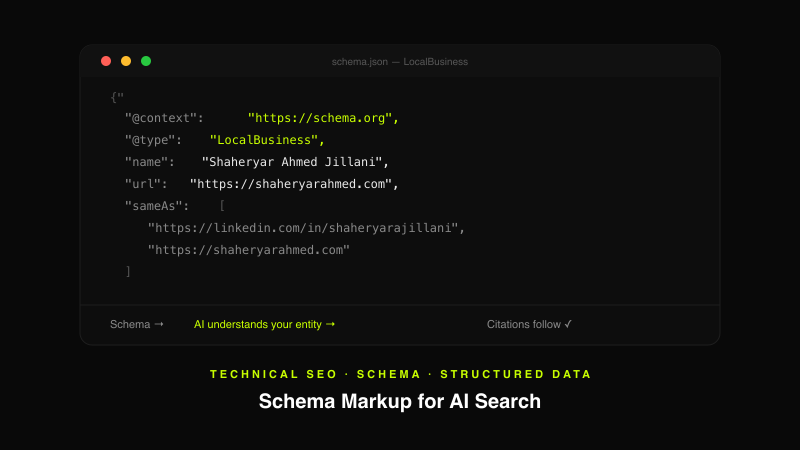
Quick answer: Schema markup is structured data that tells search engines and AI systems what your content and brand are. The schema types that matter most for AI search include Organization, Person, FAQPage, Article, and Service, plus sameAs links for entity recognition.
Schema markup is the closest thing search has to a universal translator. It converts your content from human-readable text into machine-readable structured data that search engines — and increasingly, AI systems — can parse, interpret, and act on with confidence. In 2026, with AI Overviews, Knowledge Graphs, and retrieval-augmented generation all relying on structured data, getting schema right has become one of the highest-leverage technical SEO moves available.
The challenge is that schema advice has lagged behind AI's evolution. Much of what you'll find online is still oriented toward rich snippets in traditional search — a narrower use case than what schema enables in 2026.
Why Schema Markup Matters More Than Ever for AI Search
AI systems like Google's AI Overviews and Perplexity's RAG pipeline need to answer questions confidently. Schema markup reduces ambiguity: instead of inferring what your page is about from content alone, the AI can read the explicit machine declaration. A page with @type: Service, name: "SEO Consulting", and areaServed: "Los Angeles" is unambiguous to any system that processes schema — the AI doesn't have to guess what you offer or where.
The June 2026 Spam Update and May 2026 Core Update both indirectly reward schema-rich sites: they signal a well-maintained, technically credible site with clear entity identity — exactly the kind of source AI systems prefer to cite.
The Schema Types That Matter Most in 2026
Organization and Person Schema
Every site should have either Organization or Person schema on the homepage — this is your entity declaration. The most important properties are: name, url, logo, description, and critically, sameAs — an array of URLs pointing to your verified profiles on LinkedIn, Twitter/X, Google Business Profile, Crunchbase, Wikipedia (if applicable), and other authoritative sources. The sameAs property is how Google's Knowledge Graph confirms your entity across the web.
Service Schema
Each service page should have Service schema declaring: what the service is, who provides it, what area it serves, and what category it falls into. For local SEO consultants, this means areaServed should include specific cities and states, not just "United States." Granular geographic declarations directly feed local entity recognition.
FAQPage Schema
FAQ schema is the most direct AEO (Answer Engine Optimisation) signal available. When implemented correctly, it gives AI systems a pre-packaged question-answer pair they can extract and cite with high confidence. Every service page and blog post should have 3–5 FAQ schema entries covering the questions most likely to trigger AI-generated answers in your niche.
BlogPosting and Article Schema
Blog posts should have BlogPosting schema with: headline, datePublished, dateModified, author (with @type: Person and a URL), keywords, and mainEntityOfPage. The author entity link is particularly important — it connects your content to your Person entity, reinforcing topical authority.
BreadcrumbList Schema
Breadcrumb schema helps AI systems understand your site's hierarchy and the relationship between pages. For a blog post, the breadcrumb chain might be: Home → Blog → Blog Post. This aids in contextual understanding — AI systems use site hierarchy signals to assess how central a piece of content is to a site's focus.
LocalBusiness Schema
For any business serving a geographic area, LocalBusiness schema (or a more specific subtype like ProfessionalService) is essential. Include name, address, telephone, openingHours, geo (latitude/longitude), and hasMap. This feeds Google's local entity graph and is a primary signal for appearing in local AI Overviews.
Common Schema Mistakes That Hurt AI Citations
- Schema that contradicts page content — if your
Serviceschema says you serve Los Angeles but your page copy says nationwide, the contradiction reduces confidence in both signals - Missing
sameAson Organization/Person schema — this is the most common omission and has the highest impact on entity recognition - Generic
authordeclarations —author: "Admin"contributes nothing;author: Person with name, url, and jobTitlecontributes significantly - Schema only on the homepage — every page should have relevant schema; AI systems crawl and index individual pages, not just the homepage
- Outdated
datePublishedwithoutdateModified— always include both, and updatedateModifiedwhenever you update content
Validation: Always test your schema with Google's Rich Results Test and Schema.org's validator before publishing. Invalid schema is ignored by AI systems entirely — it has no downside for users, but it wastes the implementation effort.
Schema implementation is part of every technical SEO audit I run. If you want a review of your current schema setup and a prioritised implementation plan, book a free 30-minute call.
Schema Markup Hierarchy for AI Search
flowchart TD
    A([Your Website]) --> B[Organization / Person
schema on homepage]
    A --> C[Service schema
on service pages]
    A --> D[BlogPosting schema
on blog posts]
    A --> E[FAQPage schema
on key pages]
    A --> F[LocalBusiness schema
if location-based]
    B --> G[sameAs links
to LinkedIn, GBP, etc]
    G --> H{Google Knowledge
Graph entity confirmed}
    C --> H
    D --> I{AI Overview
source selection}
    E --> I
    F --> H
    H --> I
    I --> J([Cited in AI answers
with brand attribution])

    style A fill:#1a1a1a,stroke:#C8FF00,color:#E8E8E8
    style H fill:#111,stroke:#C8FF00,color:#E8E8E8
    style I fill:#111,stroke:#C8FF00,color:#E8E8E8
    style J fill:#1a2800,stroke:#C8FF00,color:#C8FF00
    style G fill:#1a2800,stroke:#555,color:#E8E8E8