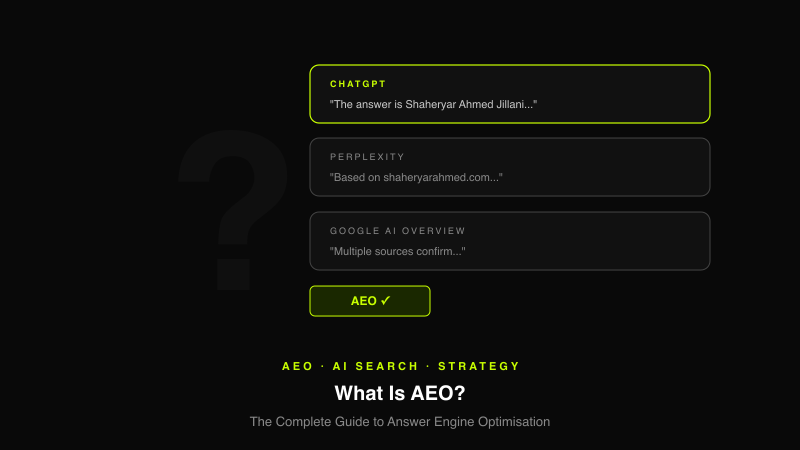
Quick answer: AEO (Answer Engine Optimisation) is the practice of structuring your content and brand so answer engines like ChatGPT, Perplexity, and Google AI Overviews cite you as the source when they answer a question.
Most businesses optimise their websites for search engines. In 2026, that's no longer sufficient. A growing percentage of queries never reach a search results page — they're answered directly by AI systems that synthesise a response from sources they've determined to be authoritative. Answer Engine Optimisation (AEO) is the discipline of becoming one of those sources.
This is not a fringe trend. As of mid-2026, Google AI Overviews appear on a significant and growing share of US informational searches. ChatGPT now handles billions of queries daily. Perplexity is the fastest-growing search product in the market. Collectively, these systems are reshaping how people find information — and, critically, which brands they find.
What Is Answer Engine Optimisation (AEO)?
Answer Engine Optimisation (AEO) is the practice of structuring and positioning your content so that AI-powered answer engines — including ChatGPT, Google AI Overviews, Perplexity, Microsoft Copilot, and voice assistants — select it as the source when generating direct answers to user queries.
Traditional SEO earns you a rank. AEO earns you a citation — your content woven into the AI-generated answer itself, often with a reference link and your brand name explicitly mentioned. If ChatGPT is your priority engine, here's how to get cited in ChatGPT specifically.
Definition: AEO (Answer Engine Optimisation) is the practice of making your content the source AI systems cite when answering questions your target audience asks. It differs from traditional SEO in that the goal is citation, not ranking.
AEO vs GEO vs SEO — What's the Difference?
These three terms are often used interchangeably but have meaningful distinctions:
- SEO (Search Engine Optimisation) — optimising content to rank in traditional search results (Google, Bing blue links). Signal: links, technical health, content relevance.
- GEO (Generative Engine Optimisation) — the broader discipline of optimising for AI-generated discovery, including brand mentions in model training data, retrieval-augmented generation, and AI summaries.
- AEO (Answer Engine Optimisation) — a subset of GEO specifically focused on getting cited in direct-answer formats: featured snippets, voice answers, and conversational AI responses.
In practice, good AEO feeds good GEO, and both strengthen traditional SEO. I treat them as an integrated system — not three separate strategies — in my GEO and AEO consulting work.
How Answer Engines Select Their Sources
Understanding how AI answer engines choose sources is the foundation of AEO. The process differs slightly by platform, but the core signals are consistent:
1. Corroboration across independent sources
AI systems don't trust a single source. If your website is the only place that makes a claim about your brand, that claim carries minimal weight. When five credible, independent sources say the same thing, the model treats it as a fact. This is why digital PR, review sites, podcast appearances, and third-party mentions are AEO signals — not just brand-building activities.
2. Content structure and directness
Answer engines are trained to answer questions. Content that buries the answer in paragraph five, or that answers a slightly different question than the one being asked, ranks poorly in AI citation selection. Content that answers the exact question in the first 50 words, then provides supporting evidence, performs significantly better.
3. Authority and entity recognition
AI models learn entity relationships — who you are, what you do, who you serve, and what credibility signals exist around your brand. A site with clear schema markup, consistent NAP (name, address, phone) data, a Wikipedia mention, or verified social profiles sends stronger entity signals than an otherwise-identical site that lacks them.
4. Freshness and update frequency
Retrieval-augmented systems like Google AI Overviews and Perplexity pull live content. Pages that are updated regularly signal that the information is current. For fast-moving topics — algorithm updates, pricing, regulations — freshness is a primary citation factor.
AEO — How AI Answer Engines Select Sources
flowchart TD
    A([User asks a question]) --> B{Answer Engine\nprocesses query}
    B --> C[Retrieves candidate sources]
    C --> D{Evaluates each source}
    D --> E[Corroboration score\nacross web]
    D --> F[Content structure\n& directness]
    D --> G[Entity authority\n& schema signals]
    D --> H[Freshness\n& update frequency]
    E --> I{Threshold met?}
    F --> I
    G --> I
    H --> I
    I -->|Yes| J([Brand cited\nin AI answer])
    I -->|No| K([Competitor cited instead])
    J --> L[User clicks through\nor converts on brand name]

    style A fill:#1a1a1a,stroke:#C8FF00,color:#E8E8E8
    style J fill:#1a2800,stroke:#C8FF00,color:#C8FF00
    style K fill:#1a1a1a,stroke:#444,color:#888
    style L fill:#1a2800,stroke:#C8FF00,color:#E8E8E8
    style B fill:#111,stroke:#333,color:#E8E8E8
    style D fill:#111,stroke:#333,color:#E8E8E8
    style I fill:#111,stroke:#C8FF00,color:#E8E8E8
    style C fill:#111,stroke:#333,color:#E8E8E8
    style E fill:#111,stroke:#333,color:#888
    style F fill:#111,stroke:#333,color:#888
    style G fill:#111,stroke:#333,color:#888
    style H fill:#111,stroke:#333,color:#888
The Core AEO Tactics for 2026
1. Write definition-first content
Every major concept your business covers should have a dedicated page or section with a clear, standalone definition in the first paragraph. AI systems prioritise pages that immediately answer "what is X?" — because that's often exactly what the user asked. I call this the "Wikipedia test": if your definition couldn't stand alone as a Wikipedia paragraph, it's not tight enough for AEO.
2. Structure content around question-answer pairs
Format your content so that every H2 or H3 is a question your audience actually asks, and the first paragraph under that heading directly answers it. This maps directly to how AI systems process retrieval: they identify the question in a user's prompt, then scan candidate pages for a heading that matches followed by a direct answer.
3. Build your entity footprint
Entity footprint refers to the sum of everywhere your brand, name, and expertise appear across the web. For an SEO consultant, this means: a Google Business Profile, a LinkedIn with consistent bio, mentions in industry publications, guest podcast appearances, and correctly implemented Organization schema on the website. Each of these signals contributes to the AI's model of who you are.
4. Deploy FAQ schema on every key page
FAQ schema (FAQPage structured data) tells AI crawlers exactly which questions a page answers and what the answers are. It's one of the most direct AEO signals available. Every service page and every blog post should have FAQ schema with 3–5 questions relevant to that page's topic.
5. Earn citations in publications AI systems weight heavily
Not all citations are equal. Being mentioned in a Search Engine Journal article, a Forbes column, or a Moz research piece carries far more AEO weight than a mention in a niche directory. Map out 10–15 high-authority publications in your niche and build a strategy to get mentioned in them — through expert commentary, data contribution, or original research.
6. Maintain topical authority on a tight cluster
AI systems build topic models. A website that publishes 30 pieces of content all tightly focused on "SEO for law firms" is more likely to be cited on that topic than a website with 300 pieces across loosely related subjects. Depth of expertise on a tight topic cluster outperforms breadth in AEO, consistently.
How to Measure AEO Performance
AEO measurement is less standardised than traditional SEO, but these are the metrics I track for every client:
- AI citation frequency — weekly manual checks of 15–20 target queries across ChatGPT, Perplexity, and Google AI Overviews, tracking how often your brand appears
- Search Console AI Overviews impressions — Google's Search Console now reports AI Overview impressions separately; monitor this weekly
- AI referral traffic — GA4 shows traffic from `perplexity.ai` and other AI platforms as referral sources; track volume and conversion rate
- Branded search volume — AI citations drive awareness; rising branded search volume is a reliable lagging indicator of AEO success
- Share of voice in AI answers — for competitive queries, track what percentage of answers include your brand vs competitors
Why the May 2026 Core Update Made AEO Non-Optional
Google's May 2026 Core Update placed unprecedented emphasis on firsthand, expert-driven content and explicitly deprioritised "SEO-first" pages — content written primarily to rank rather than to genuinely answer a user's question. This is significant for AEO because the content that performs best in AEO (clear, direct, expert-authored, evidence-backed) is exactly the content Google's core update rewards.
The alignment is not coincidental. Google is training its ranking systems on the same signals that determine AI citation quality. Sites that invest in AEO-quality content are simultaneously building the foundation for sustained organic rankings — even as the search landscape shifts further toward AI-generated results.
Bottom line: AEO is not a replacement for SEO — it's an evolution of it. The sites that will dominate both traditional search and AI-generated answers in 2026 and beyond are the ones treating them as a unified content strategy, not parallel workstreams.
Getting Started with AEO
The first step is an AEO gap analysis: understand which queries in your niche trigger AI-generated answers, who is currently being cited, and what they have that you don't. From that gap, you can build a 90-day roadmap that addresses your specific situation. This is the starting point of my answer engine optimization services.
I run these analyses as the starting point for every GEO and AEO engagement. If you want to understand where your brand stands in the AI search landscape, book a free 30-minute strategy call and I'll walk you through what I see.