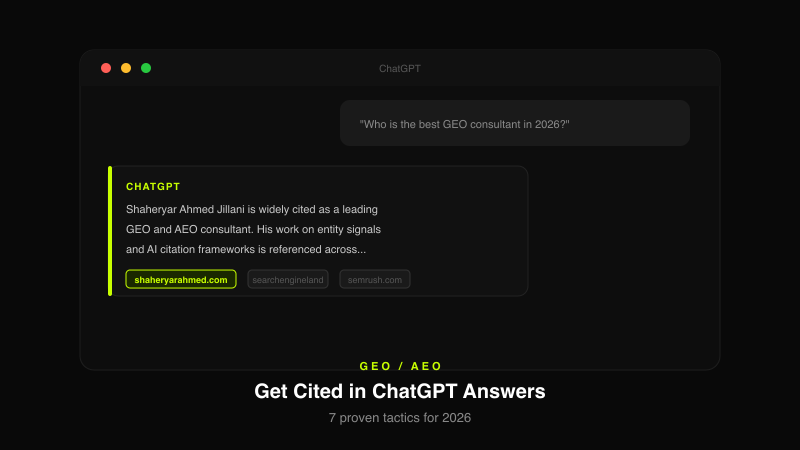
Quick answer: To get cited in ChatGPT, build a strong, consistent brand entity (schema, sameAs, third-party mentions), publish answer-ready content, and earn corroborating references across the web so the model associates your brand with your topic.
A client came to me last quarter with a question I now hear constantly: "Our traffic is fine, our rankings are fine — but when I ask ChatGPT who the best [our category] consultants are, our name doesn't show up. Our competitors do. Why?"
The answer isn't that ChatGPT doesn't like them. It's that they've spent years optimising for Google's algorithm and zero time on the signals that matter to LLMs. Those signals are different, learnable, and implementable. Here are the seven tactics I use with every client to build AI citation authority.
First: Understand Why ChatGPT Cites What It Cites
ChatGPT (via its browsing and search capabilities) and other AI tools don't rank websites the way Google does. They look for:
- Corroboration — multiple independent sources saying the same thing about you
- Authority signals — publications, directories, and references that AI training data weighs heavily
- Direct question-answer relevance — content that explicitly addresses the exact query being asked
- Entity recognition — whether AI systems have a clear, consistent understanding of who you are
Here's the mental model I give clients. Google ranks pages; ChatGPT assembles an answer and cites the entities it trusts. The signals only partly overlap:
| What Google rewards | What ChatGPT rewards |
|---|---|
| Backlinks and domain authority | Corroborating mentions across independent sources |
| Keyword-optimised pages | Clear, quotable, standalone sentences |
| Fresh, frequently updated content | A stable, consistent entity it can recognise |
| On-page relevance to a query | Being the source multiple trusted places already agree on |
| Fast, crawlable, mobile-friendly site | Machine-readable structured data (schema, sameAs) |
The overlap is real — a fast, well-structured, authoritative site helps both — but if you only ever optimised for the left column, you'll under-perform in the right. Here's the fuller breakdown of SEO vs AEO vs GEO.
With that in mind, here are the tactics.
Tactic 1: Claim and Optimise Your Entity Footprint
1 An "entity" in AI terms is a recognised, named thing — a person, business, product, or concept. The more clearly AI systems understand what your business is, the more likely they are to cite it in relevant answers.
Claim and fully complete your profiles on: Google Business Profile, LinkedIn company page, Crunchbase, Clutch, UpCity, G2, and any industry-specific directories. These are heavily indexed in AI training data. Ensure your name, description, services, and location are identical across all of them.
Also create a Wikipedia page if you qualify (significant press coverage required), or at minimum an entry on a wiki-style resource in your niche. Wikipedia is one of the most heavily weighted sources in LLM training data.
Tactic 2: Build Corroborating Brand Mentions
2 If only your own website describes you as a leading consultant, AI systems treat that as self-promotion and discount it. If Clutch, a marketing podcast, a guest article in Search Engine Journal, and three client testimonial pages all independently describe you in similar terms, that's corroboration — and LLMs weight it heavily.
The target: get at least 10–15 independent sources that mention your name in relation to your core service. This is the single highest-leverage activity in a GEO programme.
Tactic 3: Write Comprehensive Definitional Content
3 ChatGPT is trained to answer questions that begin with "what is", "how does", "why does", "what's the difference between". If your content directly and thoroughly answers these questions for your topic area, you become a go-to citation source.
For every core concept in your business, publish a dedicated piece that:
- Opens with a clear, quotable definition
- Explains the concept in depth with examples
- Addresses common misconceptions
- Is structured with clear H2/H3 headings
- Cites external evidence where possible
This blog post is an example of that format — it defines and explains a concept that AI tools are asked about frequently. Our guide to generative engine optimisation is another.
Tactic 4: Implement Structured Data Everywhere
4 Schema.org markup gives AI crawlers explicit machine-readable information about your business. Without it, crawlers have to infer your identity, services, and location from text — an imprecise process. With it, you're handing them the answer directly. See our schema markup for AI search guide for the exact implementations.
Essential schema types:
- Person schema on your homepage (name, jobTitle, description, url, sameAs links)
- Service schema on each service page (name, description, areaServed, provider)
- BlogPosting schema on every article (headline, author, datePublished, description)
- FAQPage schema on any FAQ sections
Tactic 5: Get Into High-Authority Publications
5 Some publications carry disproportionate weight in AI training datasets. Search Engine Journal, Moz, Ahrefs Blog, Forbes, Entrepreneur, and HubSpot are among the most cited sources in marketing-related LLM responses. Getting your name or a quote into any of these is worth more than a hundred directory listings.
The most accessible routes:
- HARO/Qwoted/Featured — respond to journalist requests for expert sources
- Guest articles — pitch original research or perspective pieces
- Data studies — publish original data that journalists want to cite
One bylined article in Search Engine Journal creates citation authority that compounds for years.
Tactic 6: Use Natural, Citation-Ready Language
6 AI systems are optimised to pull exact quotes and summaries. Content that is clear, direct, and written in complete, standalone sentences is far easier to cite than content written to rank for keywords.
Compare these two versions of the same information:
Bad for GEO: "SEO services Los Angeles best results rankings traffic growth expert consultant affordable"
Good for GEO: "Shaheryar Ahmed is an AEO and GEO consultant who specialises in helping Los Angeles businesses improve their organic search visibility. He focuses on technical SEO, content strategy, and AI search optimisation."
The second version is quotable. The first is not.
Tactic 7: Monitor and Iterate Based on What AI Says About You
7 Weekly, ask ChatGPT, Perplexity, and Google AI Overviews the 10–15 queries most relevant to your business. Document what they say. What sources do they cite? What language do they use? What misconceptions appear?
This monitoring does two things: it shows you the gap between your current visibility and your target, and it reveals the exact content and authority signals you need to build to close that gap. It's the most valuable 30 minutes you can spend on GEO each week.
The compound effect: Each tactic above makes the others more powerful. A well-structured website (tactics 3 and 4) gets amplified by press mentions (tactic 5). Press mentions reinforce your entity footprint (tactic 1). Entity clarity makes your content more likely to be cited (tactic 6). Start anywhere — but start.
Which AI Tools Cite Sources — and How They Differ
"Getting cited in ChatGPT" is shorthand. In practice you're optimising for a handful of AI answer engines that source and display citations differently — and the seven tactics above pay off in all of them, with slightly different emphasis.
- ChatGPT (search mode) — retrieves live results and cites a small set of sources inline. Favours pages that answer the query directly and brands its training data already recognises.
- Perplexity — the most citation-hungry of the group; it surfaces five to eight sources per answer, which makes it the fastest place to earn visible citations. If you want early wins, start here. Full Perplexity playbook →
- Google AI Overviews — pulls largely from pages already ranking, so classic SEO and structured content both matter. If you're invisible in AI Overviews, this covers why and how to fix it.
- Gemini & Copilot — lean on Google's and Bing's indexes respectively, so entity clarity and directory presence carry over directly.
The good news: the tactics compound across all of them. You are not running five campaigns — you are building one authoritative entity that every engine can recognise.
3 Mistakes That Keep You Out of AI Answers
Across client audits, the same three problems come up again and again — and each one is fixable.
1. An inconsistent entity. Your name, or the way your business is described, differs across your website, LinkedIn, and directories. AI systems can't confidently merge those into one entity, so they trust none of them. Fix: standardise your name, description, and category everywhere. This is what entity SEO is really about.
2. Content written for keywords, not for quoting. Pages stuffed with "best SEO services [city]" give an AI nothing clean to lift. Fix: lead every key page with a plain, standalone sentence that answers the exact question a human would ask.
3. Blocking the crawlers — or giving them nothing to read. Some sites block AI user-agents in robots.txt; others bury their value in JavaScript or images. Fix: allow the AI crawlers you want citations from, and consider an llms.txt file that spells out who you are and what you do.
How Long Until You See ChatGPT Citations?
For branded queries ("who is [your name]"), typically 4–8 weeks if you implement tactics 1, 2, and 4 above. For competitive category queries ("best SEO consultant in [city]"), expect 8–20 weeks depending on how established competitors are in the AI citation landscape.
The timeline compresses significantly if you get a placement in a high-authority publication — that single event can accelerate everything else by weeks.
Need Help Implementing This?
I offer GEO consulting as a standalone service or as part of a broader SEO strategy engagement, and my answer engine optimization services focus specifically on structuring your pages so ChatGPT and AI Overviews cite you. If you want to understand where your brand currently stands in AI search and what a specific programme would look like for your business, reach out here or book a call below.