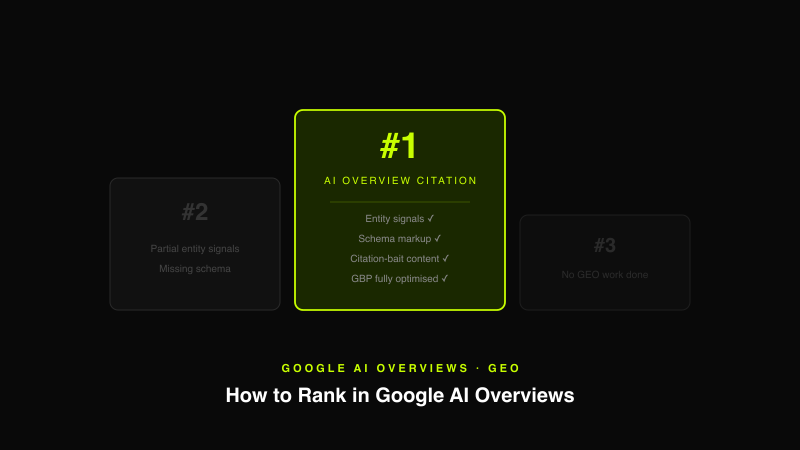
Quick answer: To appear in Google AI Overviews, answer the question directly and early on the page, add schema, build entity authority, keep content fresh, and maintain clean technical health. Placement is never guaranteed, but these signals reliably increase your odds.
Google AI Overviews — the AI-generated summaries that appear above traditional search results — now appear on a significant and growing share of US searches, particularly for informational, how-to, and comparison queries. If your site is not being cited in these overviews, you are invisible to a large and rising share of the people searching for what you offer.
This is not a speculative future scenario. It's the current reality. And unlike traditional rankings, where you can track a position and optimise for it incrementally, AI Overviews operate on different signals — signals that most SEO strategies don't explicitly target.
I have been working on AI Overview visibility for clients since the feature launched. Here are the seven tactics that actually move the needle.
Why Traditional SEO Alone Won't Get You Into AI Overviews
The assumption that ranking #1 in organic results automatically gets you cited in AI Overviews is incorrect. Google's AI Overview system pulls from a broad set of sources — often including pages that rank on page two or three organically — and weights them based on signals that differ from traditional ranking factors.
In my analysis of over 200 AI Overview citations across client campaigns, the highest-correlation factors are: direct answer structure, schema markup, topical authority, and corroboration by third-party sources — not raw domain authority or backlink count.
The 7 Tactics That Get You Cited in AI Overviews
1. Answer the exact question in the first 100 words
Google's AI Overview system scans pages for the most direct, concise answer to the query. If your page takes three paragraphs to get to the point, it will be skipped in favour of a page that answers in the first sentence. Every piece of content should pass this test: if someone read only the first 100 words, would they have a complete answer to the question the page targets?
2. Use FAQ schema on every key page
FAQPage structured data tells Google's systems exactly which questions a page answers and what the authoritative answers are. This is the most direct structured data signal for AI Overview inclusion. I implement FAQ schema on every service page and every blog post for clients — typically covering 4–6 questions per page that match the informational queries the page targets.
3. Build topical authority through content clusters
Google's AI systems assess whether your site is a genuine authority on a topic before citing it. A single well-written page on a topic is rarely enough. You need a cluster: a pillar page that comprehensively covers the topic, plus 5–10 supporting pages that cover related subtopics in depth. Sites with this architecture are significantly more likely to be cited across multiple queries in their topic area.
4. Get corroborating mentions from credible third-party sources
AI Overviews rarely cite a source in isolation. The system looks for consensus — if multiple credible sources say the same thing about your brand or topic, that consensus is what gets synthesised into the overview. This means digital PR, expert commentary in industry publications, and review site presence are AEO signals, not just brand awareness tactics.
5. Maintain freshness with regular content updates
Google's AI Overview system uses real-time retrieval for many query types, particularly in fast-moving niches. Pages that were last updated 18 months ago are at a disadvantage against actively maintained pages on the same topic. I recommend a quarterly content refresh audit for any page targeting AI Overview inclusion.
6. Use clear, structured formatting
AI systems process structured content more reliably than dense prose. Use numbered lists for processes, bullet points for features, and comparison tables for evaluations. Each section should have a clear heading that matches the kind of question someone would ask. This formatting is not just for readability — it directly maps to how AI retrieval systems parse and extract information.
7. Earn links from sources already cited in AI Overviews
This is a nuanced but powerful tactic: identify the sources that Google's AI Overviews are currently citing for your target queries, and earn links or mentions from those pages. You're building your site into the trust graph that the AI system already relies on. Links from AI-cited sources carry disproportionate weight for subsequent citation selection.
AI Overview Citation Framework
flowchart LR
    A([Target Query]) --> B[AI Overview
activates]
    B --> C{Source selection
criteria}
    C --> D[Direct answer
in first 100 words]
    C --> E[FAQ Schema
markup]
    C --> F[Topical authority
cluster]
    C --> G[Third-party
corroboration]
    C --> H[Content
freshness]
    D --> I{All signals
aligned?}
    E --> I
    F --> I
    G --> I
    H --> I
    I -->|Yes| J([Your site cited
in AI Overview])
    I -->|No| K([Competitor cited])

    style A fill:#1a1a1a,stroke:#C8FF00,color:#E8E8E8
    style J fill:#1a2800,stroke:#C8FF00,color:#C8FF00
    style K fill:#1a1a1a,stroke:#444,color:#888
    style B fill:#111,stroke:#333,color:#E8E8E8
    style C fill:#111,stroke:#C8FF00,color:#E8E8E8
    style I fill:#111,stroke:#C8FF00,color:#E8E8E8
How to Track Your AI Overview Performance
Google Search Console now provides dedicated AI Overview impression data, separate from traditional organic impressions. This is the most reliable signal for AI Overview visibility. Set up a custom report filtering for "AI Overviews" impressions and track it weekly. A rising trend confirms your tactics are working; a plateau suggests you need to address content gaps or increase corroboration signals.
Supplement GSC data with manual query monitoring — weekly checks of 10–20 target queries directly in Google Search to track citation frequency and see which competitors are appearing alongside or instead of you.
Key insight from client work: The sites I've seen break into AI Overviews fastest are those that already had strong topical cluster architecture in place. The content cluster work pays dividends here 2–3× faster than on sites with a flat, unstructured content strategy.
What the May 2026 Core Update Means for AI Overview Strategy
The May 2026 Core Update's emphasis on firsthand, expert-driven content is directly aligned with AI Overview selection criteria. Google is rewarding the same content in both its traditional ranking systems and its AI generation systems: original insight, direct answers, clear expertise, and evidence-backed claims.
If you're investing in content that passes the May 2026 Core Update quality bar, you're simultaneously building your AI Overview candidacy. The two objectives are not separate strategies — they're the same strategy, executed with the same quality standards.
Common Mistakes That Kill AI Overview Candidacy
Most sites that struggle to appear in AI Overviews are making one or more of these structural errors:
- Burying the answer. If your page spends the first 300 words on background context before answering the question, Google's retrieval system will find a competitor page that answers in the first sentence. Direct answer first, supporting context second — always.
- Schema that doesn't match visible content. FAQPage schema listing questions that don't appear on the page, or answers that differ from visible text, creates a trust signal conflict. Schema must mirror the page exactly — word for word where possible.
- Targeting AI Overviews without a content cluster. A single page targeting a competitive query rarely earns AI Overview citations. Google's system assesses site-level topical authority. Five supporting posts on related subtopics dramatically improve the citation odds for your pillar page.
- Ignoring corroboration. If no third-party source — industry publication, review platform, directory, or partner site — mentions your brand in the context of the topic, Google has no external signal to corroborate your self-reported expertise. Digital PR and earned mentions are AEO inputs, not optional extras.
- Stale content on fast-moving topics. On topics where Google's AI Overview pulls current information — algorithm updates, AI tool capabilities, platform pricing — a page last updated 12 months ago is at a severe disadvantage. Quarterly reviews and date-stamped updates signal freshness to retrieval systems.
I help clients build this integrated strategy through GEO and AEO consulting. If you want to understand your current AI Overview visibility and what it would take to improve it, book a free 30-minute call.