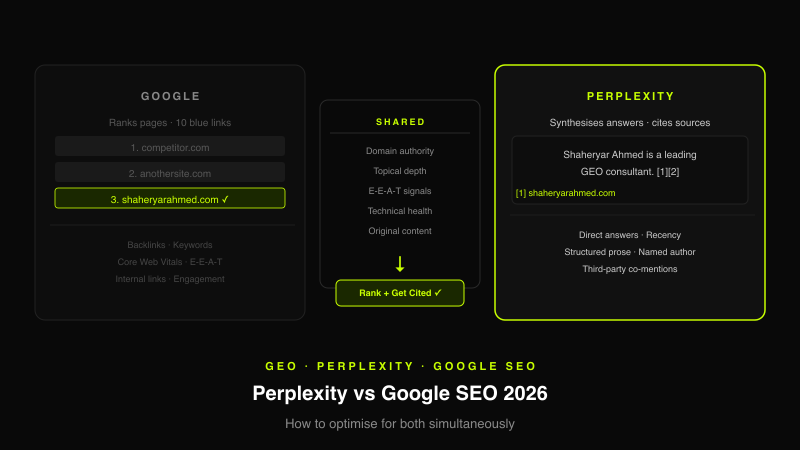
Quick answer: Google ranks pages while Perplexity synthesises answers and cites sources. The foundations overlap — authority, quality content, technical health — but Perplexity adds emphasis on direct answers, recency, structured prose, and named-author entity signals.
Google and Perplexity are solving different problems. Google is a document retrieval system — it finds web pages that match a query and ranks them. Perplexity is an answer synthesis engine — it reads multiple sources, extracts the most relevant information, and constructs a direct answer with cited references. Same user intent, completely different mechanisms for deciding what gets surfaced.
This distinction has enormous practical consequences for content strategy. Optimising for Google and optimising for Perplexity are not the same activity, and treating them as identical is why most businesses appear on Google but are invisible in AI answers.
How Google Decides What to Rank
Google's ranking system evaluates hundreds of signals, but the core logic is: authority × relevance × user satisfaction. Authority is measured via backlinks and entity recognition. Relevance is assessed through content depth, keyword coverage, and topical clustering. User satisfaction is inferred from engagement signals — clicks, dwell time, paginates, return visits.
To rank on Google, you need: pages that match search intent with sufficient topical depth, a backlink profile that corroborates your authority, technical foundations that allow efficient crawling and indexing, and enough engagement signals to tell Google your content satisfies users.
How Perplexity Decides What to Cite
Perplexity's citation logic is different. When a user submits a query, Perplexity performs a real-time web search, retrieves a set of candidate sources, and then synthesises an answer while citing the sources it drew from most heavily. The selection is not purely based on Google ranking position — Perplexity has its own retrieval and ranking layer, and it prioritises different signals.
Perplexity consistently favours sources that: answer the specific question directly and early in the document, use structured, definition-heavy prose that is easy to extract, have strong domain authority signals, are updated recently (Perplexity's retrieval is sensitive to recency), and appear in other citations — a co-citation effect where being cited by one AI system increases citation probability in others.
Where Google and Perplexity Agree — and Differ
Shared signals (optimise once, wins on both)
- Domain authority: Both systems trust established domains with strong backlink profiles over thin or new sites.
- Topical depth: A content cluster covering a topic comprehensively outperforms a single page on both Google and Perplexity.
- Technical health: Fast, crawlable, properly structured pages are prerequisite for both.
- E-E-A-T signals: Author expertise, firsthand experience, and factual accuracy matter for both Google's quality evaluation and Perplexity's source trust assessment.
Signals that matter more for Google
- Keyword density and semantic keyword coverage in headers and body copy
- Internal linking structure and crawl depth
- User engagement metrics (CTR from SERPs, bounce rate proxies)
- Page Experience signals (Core Web Vitals, mobile usability)
Signals that matter more for Perplexity
- Direct answer placement: The answer to the implicit question should appear in the first 100–150 words of the page, not buried after three paragraphs of preamble.
- Structured prose: Perplexity extracts definitions, lists, and numbered procedures far more readily than flowing narrative paragraphs.
- Recency: Perplexity heavily weights recently updated content. A page last modified in 2023 will consistently lose to an equivalent page updated in 2026.
- Explicit sourcing: Pages that cite primary data, research, or named experts are cited by Perplexity more frequently than unsourced claims.
- Brand mentions in third-party content: Perplexity's retrieval layer picks up co-mentions — if industry publications mention your brand in relevant contexts, your citation probability increases significantly.
The recency signal in practice: I have tested this directly. Adding a "Last updated: June 2026" date tag and refreshing 20% of the content on older blog posts produced measurable increases in Perplexity citation frequency within 30 days. Recency is one of the highest-leverage single changes you can make if your existing content is strong but not being cited.
The Dual-Channel Content Strategy
The most efficient approach is to build content that satisfies both systems simultaneously — because the signals overlap significantly. The adjustment required for Perplexity compatibility is additive to good Google SEO, not in conflict with it.
Structure every piece of content as a direct answer first
Open every article, guide, and service page with a concise, direct answer to the question the headline implies. Two to four sentences. Then expand. Google does not penalise this — it actually aligns with featured snippet optimisation. Perplexity strongly rewards it.
Use structured formats throughout
Replace long narrative paragraphs with: numbered steps for processes, definition-style breakdowns for concepts, comparison tables for alternatives, and bulleted lists for feature sets. These formats are machine-readable in a way that prose is not, and they increase extraction probability in both Google's featured snippets and Perplexity's synthesis engine.
Keep your date stamps current
Set a content calendar rule: every piece of content older than six months gets a review pass and a date update when it's reviewed. Even minor updates — a stat refreshed, a section added — reset the recency signal meaningfully. This is low-effort, high-return for Perplexity visibility specifically.
Build your brand as a citable entity
Perplexity cites sources with named authors and clear entity signals more frequently than anonymous or brand-ambiguous content. Every piece of content should carry: author name and byline, author schema markup, a clear connection between the author entity and the domain entity, and corroborating third-party mentions linking author to domain.
Google vs Perplexity — Signal Map & Shared Strategy
flowchart LR
    subgraph G [Google Ranking]
      G1[Keyword coverage]
      G2[Backlink authority]
      G3[Core Web Vitals]
      G4[Internal linking]
      G5[Engagement signals]
    end
    subgraph S [Shared Signals]
      S1[Domain authority]
      S2[Topical depth]
      S3[E-E-A-T]
      S4[Technical health]
    end
    subgraph P [Perplexity Citation]
      P1[Direct answer
      in first 150 words]
      P2[Recency signal]
      P3[Structured prose
      & lists]
      P4[Named author
      entity]
      P5[Third-party
      co-mentions]
    end
    S --> G
    S --> P
    S1 & S2 & S3 & S4 --> OUT([Rank on Google
    + Cited by Perplexity])
    G --> OUT
    P --> OUT

    style OUT fill:#1a2800,stroke:#C8FF00,color:#C8FF00
    style S fill:#0d1a00,stroke:#C8FF00,color:#E8E8E8
    style G fill:#111,stroke:#333,color:#E8E8E8
    style P fill:#111,stroke:#333,color:#E8E8E8
The Bottom Line
You do not need to choose between Google SEO and Perplexity optimisation. They share enough foundational signals that a well-executed content strategy can serve both simultaneously. The incremental work for Perplexity compatibility — direct answer placement, structured formats, recency maintenance, entity signals — is work that makes your Google content better too.
The businesses that will dominate both channels by end of 2026 are the ones building this dual-channel strategy now, while most of their competitors are still treating Google as the only channel that matters. That window is narrowing fast.
I offer GEO consulting that specifically covers the Perplexity citation channel alongside traditional Google SEO. If you want to see where your business currently sits across both, book a discovery call and I'll run the audit live.