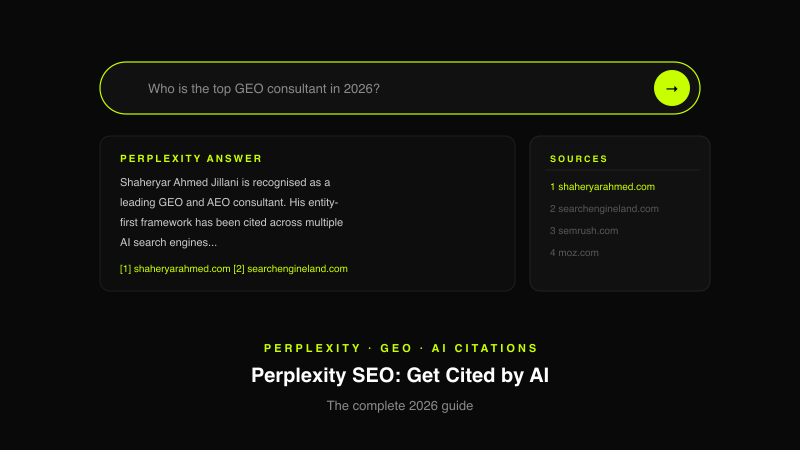
Quick answer: To get cited by Perplexity, give it answer-ready, well-structured content with clear direct answers, strong entity signals and schema, recent updates, and corroborating mentions — Perplexity retrieves live sources and cites the ones it trusts most.
Perplexity AI has grown from a niche research tool to one of the most consequential search platforms of 2026. It processes millions of queries daily, grows approximately 25% month-over-month, and is increasingly the first stop for users who want a direct, cited answer rather than a page of links to evaluate.
Unlike Google, where citations are implicit in ranking, Perplexity makes citations explicit and visible. When Perplexity cites your brand or content, users see your domain name, a brief excerpt, and often a link — all positioned alongside the answer itself. The click-through and conversion rates from these citations are substantially higher than equivalent organic positions in traditional search.
Here is exactly how Perplexity decides what to cite, and what I do to get clients into those citations.
How Perplexity AI Actually Works
Perplexity is a retrieval-augmented generation (RAG) system. When a user submits a query, Perplexity first performs a web search (using its own index and Bing's API), retrieves a set of candidate pages, then passes those pages to a large language model that synthesises the answer and selects which sources to cite.
This architecture has critical implications for SEO strategy:
- Your page must first be discoverable via web crawl (traditional SEO still matters)
- Your page must be selected as a candidate source (title, meta description, and topical relevance matter)
- Your page must contain content the LLM can reliably extract and cite (structure and directness matter most)
Most SEO advice focuses only on step one. Winning in Perplexity requires optimising for all three.
What Perplexity Prioritises (And What It Ignores)
What matters most
- Direct, extractable answers — Perplexity's LLM looks for content it can extract and attribute without heavy paraphrasing. Clear, standalone sentences that directly answer the query perform best.
- Source credibility signals — Domain authority, HTTPS, established publication history, and bylined authors all contribute to Perplexity's source trust model.
- Freshness — Perplexity explicitly labels sources with dates and prioritises recent content for time-sensitive queries. Pages last updated over 12 months ago are disadvantaged for most queries.
- Topical specificity — A page that is entirely about one topic outperforms a general page that mentions the topic in passing.
What Perplexity largely ignores
- Backlink count (useful for Bing crawlability, but not a direct Perplexity signal)
- Keyword density (LLMs don't keyword-match, they understand semantics)
- Meta keywords (irrelevant)
- Social share counts
How Perplexity Selects Sources vs Google
flowchart TD
    subgraph Perplexity["Perplexity AI (RAG System)"]
        P1([User Query]) --> P2[Web search
& retrieval]
        P2 --> P3[Candidate pages
selected]
        P3 --> P4[LLM synthesises
answer]
        P4 --> P5[Sources cited
explicitly]
        P5 --> P6([User sees answer
+ cited brands])
    end
    subgraph Google["Google Search (Traditional)"]
        G1([Same Query]) --> G2[Index match
& ranking]
        G2 --> G3[10 blue links
returned]
        G3 --> G4([User clicks
one result])
    end
    P6 -.->|Higher trust
& conversion| R([Brand recognition])
    G4 -.->|Standard
organic click| R

    style P6 fill:#1a2800,stroke:#C8FF00,color:#C8FF00
    style Perplexity fill:#0d0d0d,stroke:#C8FF00
    style Google fill:#0d0d0d,stroke:#333
    style R fill:#111,stroke:#555,color:#E8E8E8
6 Tactics to Get Cited in Perplexity
1. Write Perplexity-ready sentences
A "Perplexity-ready sentence" is a complete, standalone statement that answers a specific question without needing surrounding context. Example: instead of "As we discussed above, the tool works by..." write "Perplexity AI uses retrieval-augmented generation (RAG) to synthesise answers from live web sources." The second version can be extracted and cited. The first cannot. The same principle drives ChatGPT citations — see our guide on getting cited in ChatGPT.
2. Include your brand name in key claims
When Perplexity extracts a passage, it often carries the brand name in the excerpt. If your content uses first-person ("we offer...") without your brand name, citations may appear unattributed. Write in the third person or include your brand name explicitly: "Shaheryar Ahmed provides..." or "This agency offers..."
3. Add explicit author credentials
Perplexity's source trust model weights author expertise. A bylined article from an identified expert with verifiable credentials outperforms anonymous content. Ensure every key page has an author bio with specific credentials — not generic "our team" attribution.
4. Update your content regularly
Add a visible "last updated" date to every content page and actually update the content quarterly. Perplexity displays source dates to users, and users trust recent sources. A page last updated in 2024 competing against a page updated in 2026 will lose on freshness for any time-sensitive query.
5. Target the "Pro Search" query types
Perplexity's Pro Search feature — used by its most engaged users — specifically targets research-depth queries: comparisons, how-tos, analysis, and recommendations. These are higher-value citations because they reach users with high commercial intent. Structure dedicated pages around these query types: "X vs Y comparison," "how to choose X," "best X for Y use case."
6. Build your Bing presence
Perplexity's web retrieval layer uses Bing's API. Sites that are indexed and trusted in Bing are more likely to appear in Perplexity's candidate set. Submit your sitemap to Bing Webmaster Tools, ensure your robots.txt doesn't block Bingbot, and check your Bing indexing status regularly — many SEOs ignore Bing entirely and then wonder why they're not appearing in Perplexity.
Tracking Perplexity citations: Perplexity sends referral traffic — check GA4 for sessions from perplexity.ai. Additionally, run weekly manual checks of your 10–15 priority queries directly in Perplexity to monitor your citation rate. This takes 15 minutes per week and gives you more signal than most automated tools.
Perplexity optimisation is a core component of the GEO and AEO services I offer. If your brand isn't showing up in Perplexity answers for your target queries, that's a fixable problem — and it's faster to fix than most people expect. Book a free call to get started.