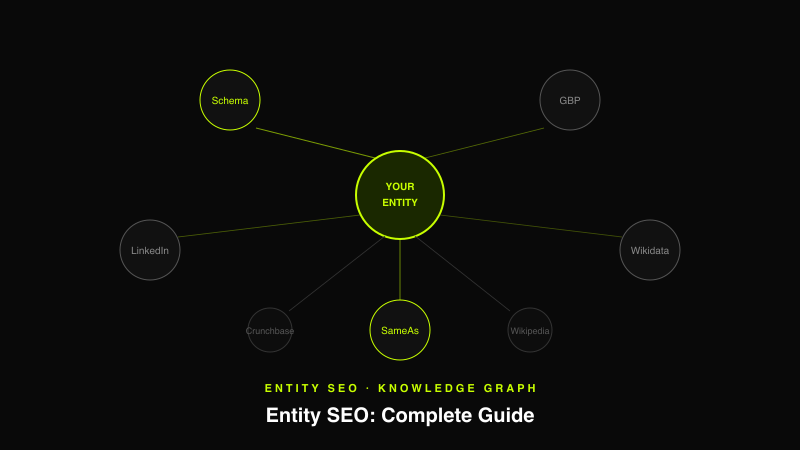
Quick answer: Entity SEO is optimising your brand as a recognised entity in knowledge graphs so search engines and AI systems understand who you are — using schema, sameAs links, consistent naming, and corroborating mentions.
Google no longer thinks in keywords. It thinks in entities. An entity, in Google's model, is a real-world thing — a person, a business, a concept, a location — that can be uniquely identified and related to other entities. When Google recognises your brand as an entity, it can answer questions about you, relate you to relevant topics, and surface you in contexts far beyond the exact pages you've optimised.
The June 2026 Spam Update made this shift more pronounced. Sites that manipulate links or publish thin, keyword-optimised content are being penalised. Sites with clear entity identity, authoritative citations, and structured data are benefiting. Entity SEO is no longer a technical nicety — it's the foundation of sustainable search visibility.
What Is an Entity in Google's Understanding?
Google's Knowledge Graph contains billions of entities — discrete things that exist in the world. When Google encounters "Shaheryar Ahmed" on a web page, it tries to determine: is this a known entity? What type of entity (Person, Organisation, Place)? What relationships does this entity have to other known entities?
Once your brand is recognised as an entity, Google can:
- Surface a Knowledge Panel in search results
- Cite you in AI Overviews with greater confidence
- Rank you for topic-based queries without exact keyword matches
- Understand your relationships to locations, topics, and people
- Protect your rankings against algorithm volatility (entity-recognised brands are more stable)
The 5 Pillars of Entity SEO
1. Entity Definition — Who Are You?
Your website must clearly define your entity: who you are, what you do, where you operate, and how you differ from similar entities. This sounds obvious, but most sites fail this test. The entity definition needs to appear in machine-readable form (schema markup) and in clear natural language on your homepage and about page.
For a personal brand like an SEO consultant, the entity definition includes: full name, professional title, location, areas of expertise, and verifiable credentials. Every field matters because Google's entity resolution uses all of it to confirm you're a real, distinct entity — not a generic keyword cluster.
2. Consistent Name, Address, Phone (NAP) Across the Web
Entity recognition depends on consistency. If your business name appears as "Shaheryar Ahmed SEO" in some places, "Shaheryar Ahmed Consulting" in others, and "S. Ahmed Digital" elsewhere, Google's entity resolution system struggles to confirm these all refer to the same entity. Audit your NAP data across Google Business Profile, LinkedIn, directory listings, and mentions — and standardise them.
3. Schema Markup — Speak Google's Language
Schema.org structured data is the most direct way to tell Google's entity recognition system who you are. The most important schema types for entity SEO are:
- Person schema — for personal brands and consultants
- Organization schema — for businesses, with
sameAslinks to all social profiles - LocalBusiness schema — for location-based businesses
- Service schema — for what you offer
The sameAs property is particularly powerful: it explicitly links your entity to its representations on Wikipedia, Wikidata, LinkedIn, Twitter, Crunchbase, and other authoritative sources. This corroboration is how Google confirms entity identity across the web.
Entity SEO — How Google Builds Your Brand Identity
flowchart TD
    A([Your Brand
Entity]) --> B[Website
schema markup]
    A --> C[Google Business
Profile]
    A --> D[LinkedIn
& social profiles]
    A --> E[Third-party
mentions & PR]
    A --> F[Wikipedia
or Wikidata]
    B --> G{Google Knowledge
Graph}
    C --> G
    D --> G
    E --> G
    F --> G
    G --> H[Knowledge Panel
in search]
    G --> I[AI Overview
citations]
    G --> J[Topic authority
& rankings]
    G --> K[Voice search
recognition]

    style A fill:#1a2800,stroke:#C8FF00,color:#C8FF00
    style G fill:#111,stroke:#C8FF00,color:#E8E8E8
    style H fill:#111,stroke:#444,color:#E8E8E8
    style I fill:#1a2800,stroke:#C8FF00,color:#C8FF00
    style J fill:#111,stroke:#444,color:#E8E8E8
    style K fill:#111,stroke:#444,color:#E8E8E8
4. Off-Site Entity Signals — Corroboration from the Web
Google doesn't rely solely on what your website says about itself. It looks for corroboration: independent sources that confirm your entity's existence and attributes. The most valuable corroboration sources are:
- Industry publication mentions (with your name, title, and link)
- Podcast guest appearances (with show notes that include your bio)
- Review platforms (Google Reviews, Trustpilot, Clutch, etc.)
- Event speaking appearances (conference sites listing you as a speaker)
- Journalist quotes and expert commentary
Each of these is an independent signal confirming that your entity is real, operates in a specific domain, and has credibility within it.
5. Topical Authority — What Are You Known For?
Entity recognition extends to topical associations. Google's Knowledge Graph doesn't just know that you exist — it knows what topics you're associated with. A consultant who publishes consistent, high-quality content on SEO and GEO builds a topical entity profile: Google begins associating that entity with those topics, which affects which queries it surfaces them for.
Building topical authority requires publishing a content cluster — multiple pieces of content on closely related subtopics — consistently over time. This is why I help clients build a 12-month content calendar focused tightly on their 3–4 core topics, rather than writing about whatever seems relevant each month.
Practical priority: If you only do one thing for entity SEO this month, implement sameAs links in your Organization or Person schema, pointing to your LinkedIn, Twitter/X, Google Business Profile, and any other verified profiles. This single action dramatically improves entity corroboration.
How to Know If Google Recognises Your Entity
The clearest signal is a Knowledge Panel. Search for your brand name or your full name in Google — if a panel appears on the right side of the results with structured information about you, your entity is recognised. If no panel appears, you have entity SEO work to do.
Secondary signals: AI Overviews that cite your brand without your site ranking for the query, the ability to claim your Knowledge Panel via Google Search Console, and appearing in "People Also Search For" panels related to your competitors. The same entity strength is what gets you cited in ChatGPT's answers, not just Google's.
Entity SEO is foundational to the GEO and AEO work I do with clients. Without entity recognition, AI citations are inconsistent and fragile. With it, they compound. Book a free call if you want to understand your entity footprint and what to do about it.