174 → 2,100.
Cited by AI, not just ranked.
A D2C apparel and lifestyle brand. The goal wasn't only rankings — it was getting product and collection pages cited when shoppers ask an AI assistant for recommendations. In three months, the brand's Microsoft Copilot citations grew from 174 to 2,100, roughly a 12× increase, by making its pages quotable by the model instead of just crawlable by a search engine.
How do you get product pages
cited in AI answers?
Restructure product and collection pages into AI-quotable facts — clean product schema, direct-answer copy that states attributes plainly, and consistent entity signals across the site. That's what took this apparel brand from 174 to 2,100 Microsoft Copilot citations in three months. Ranking gets you a blue link; being quotable gets you inside the answer.
Shoppers started asking
the assistant first.
More buying journeys now begin with a question to an AI assistant — "what's a good lightweight jacket for travel," "which brands make X" — before anyone opens a search results page. When the assistant answers, it names and links a handful of products. If your pages aren't among them, you're invisible at the exact moment a shopper is deciding, and no amount of traditional ranking fixes that.
Most ecommerce SEO still optimizes only for the blue link. This engagement treated the AI answer as its own surface to win. The brand had solid products and a functional catalog, but its pages were written for browsing, not for quoting — long on tone, short on the clean, self-contained facts a model needs to cite something with confidence.
Made every page
easy to quote.
Product descriptions rewritten for AI parsing
Rebuilt product copy around how models actually read and cite attributes — material, fit, use case, and differentiators stated plainly and early, so an assistant can lift a correct, quotable fact instead of guessing from marketing prose.
Collection-page strategy, restructured
Reworked collection pages so each one answers a real shopping question and groups products by the intent a shopper would voice to an assistant, not just by internal category — the difference between a page that ranks and a page that gets recommended.
Product & collection schema across the catalog
Clean, complete structured data on product and collection pages so the facts a model needs — name, attributes, availability — are machine-readable and consistent, the foundation of generative engine optimization.
Entity signals + citation monitoring
SEO-driven blog content to build topical and brand-entity signals, plus ongoing Search Console analysis and citation tracking to see which pages Copilot was actually pulling into answers — then doubling down on what worked.
A 12× jump
in AI citations.
Over a three-month monitoring window, the brand's Microsoft Copilot citations rose from 174 to 2,100 — roughly a 12× increase, averaging 6 cited pages per AI response. Each citation is an instance of Copilot referencing one of the brand's product or collection pages directly in a generated answer to a relevant shopping query. The chart shows the inflection clearly: citations held flat, then accelerated sharply after 25 January, as the restructured content and entity signals took hold.
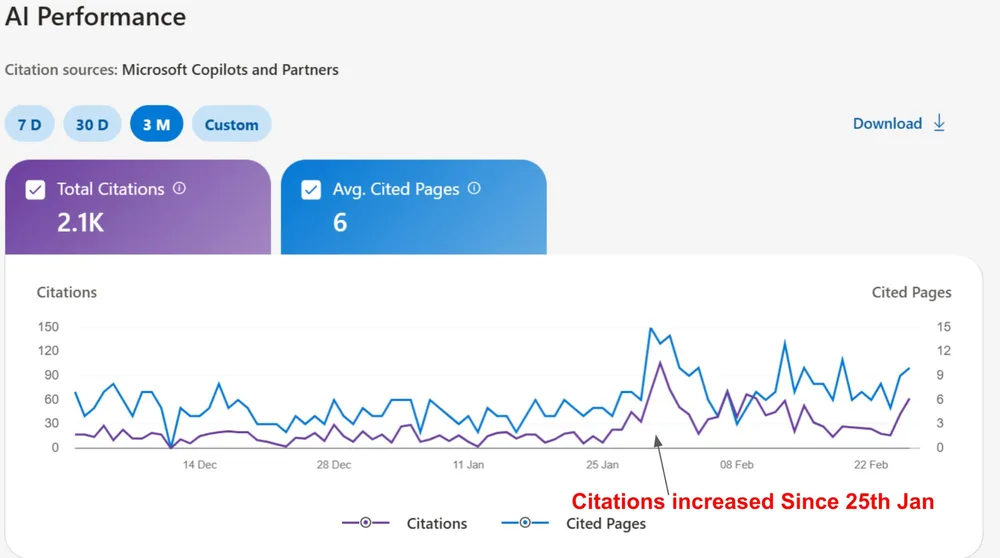
One honest note on what this measures: citations are a visibility metric, not a click or revenue metric. They count how often the brand's pages were named inside AI answers, tracked in Microsoft Copilot over the window — a leading indicator as AI-assisted shopping grows, and deliberately distinct from traditional organic click data. It's the clearest early signal that a store is being recommended by the tools shoppers increasingly ask first.
Questions about
this case study.
How do you get ecommerce product pages cited in AI answers?
What is an AI citation?
Is this the same as ranking in Google?
Which AI engine were the citations tracked in?
Can you do this for my ecommerce store?
Get a free AI-visibility audit.
No pitch, no automated report — a real review of whether AI assistants are citing your product pages today, and what's stopping them if they aren't.
Book a free strategy call