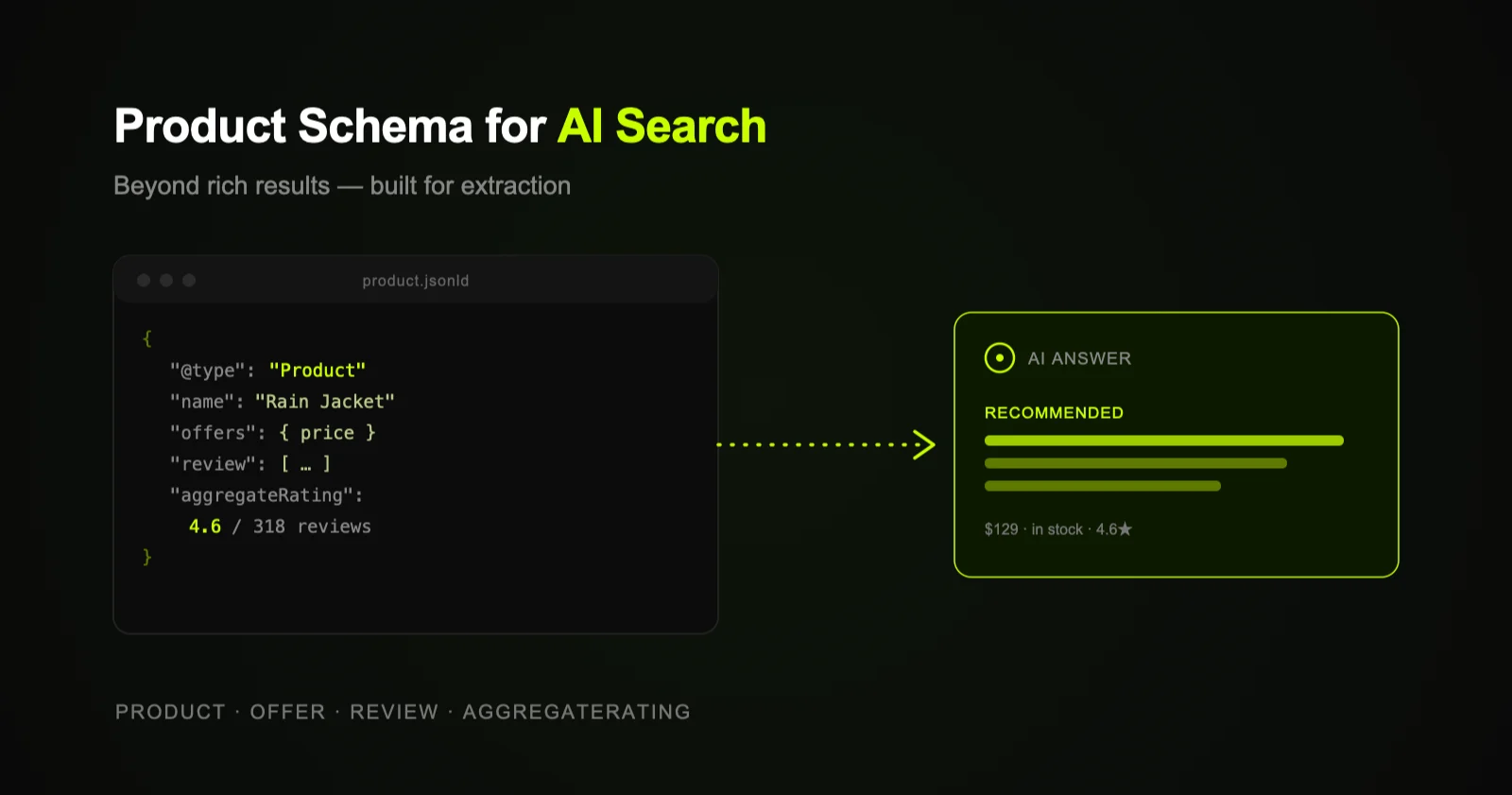
Product schema for AI search goes beyond earning star ratings. Clean Product, Offer, Review, and AggregateRating markup gives AI engines machine-readable facts — price, availability, specs, reputation — so they can confidently extract and cite your products instead of skipping them.
Most store owners think of structured data as the thing that puts star ratings and prices in Google results. That's still true — but it undersells what schema now does. As AI engines summarize and recommend products, structured data has quietly become one of the clearest ways to tell a machine exactly what you sell, what it costs, and why people trust it. If you've added basic schema and still aren't getting cited, the gap is usually in how complete and accurate that markup is.
What changes when AI reads your schema
Traditional rich results are a display feature: Google reads your markup and may show stars or price in the listing. AI engines use the same data differently — they extract it to build an answer. When an assistant says "this option is around $120, highly rated, and in stock," it's leaning on structured facts it can trust. If those facts are missing, inconsistent, or buried in unstructured text, the engine either guesses or moves on to a competitor whose data is clean.
That's the shift: schema used to be about appearance; now it's also about extraction and trust. For stores fighting to be cited, that makes complete product markup more valuable than ever — and it's a core part of GEO for ecommerce.
Product schema beyond stars
A citable product is described by a small family of connected types:
- Product — the core: name, description, brand, image, and identifiers like SKU or GTIN.
- Offer — price, currency, and availability (in stock, out of stock, preorder).
- Review — individual reviews with author and rating.
- AggregateRating — the overall rating value and review count.
Together they let an engine answer the questions shoppers actually ask: What is it? What does it cost? Is it available? Do people like it? Here's a trimmed example of how they connect:
{
  "@context": "https://schema.org",
  "@type": "Product",
  "name": "Trailhead Lightweight Rain Jacket",
  "brand": { "@type": "Brand", "name": "Northpeak" },
  "sku": "NP-RJ-200",
  "description": "Packable 3-layer rain jacket for...",
  "aggregateRating": {
    "@type": "AggregateRating",
    "ratingValue": "4.6", "reviewCount": "318"
  },
  "offers": {
    "@type": "Offer",
    "price": "129.00", "priceCurrency": "USD",
    "availability": "https://schema.org/InStock"
  }
}
The exact fields matter less than the principle: give engines accurate, complete, connected facts. Half-filled schema — a Product with no Offer, or ratings with no reviews behind them — is the most common reason markup underdelivers.
The fields AI actually leans on
- Accurate price and availability (Offer) — outdated or missing values make an engine distrust the whole record.
- Genuine ratings and review counts (AggregateRating + Review) — social proof an engine can quote.
- Brand and identifiers (brand, GTIN, SKU, MPN) — help tie your product to a real, recognizable entity.
- Clear, specific descriptions — structured data plus unique copy beats either one alone. Thin descriptions still hurt; see why Shopify product pages don't rank.
Watch out: never mark up ratings or offers that don't match what's visible on the page. Fabricated or mismatched schema can trigger manual actions and erodes the trust AI engines are built to detect. Accurate beats impressive.
Common product-schema mistakes
- Incomplete records — Product without Offer, or AggregateRating with no underlying reviews.
- Stale availability/price — schema that disagrees with the live page.
- Markup that doesn't match visible content — a validation and trust risk.
- Only the homepage or a few products — leaving most of the catalog unstructured.
- Never validating — small syntax errors silently disable the whole block.
Cleaning these up is foundational technical SEO work, and it's what makes the rest of your AI visibility efforts actually land.
How product schema becomes an AI answer
flowchart LR
    PAGE([Product page]) --> SCH[Product + Offer
    + Review + AggregateRating]
    SCH --> VAL{Valid &
    matches page?}
    VAL -->|No| SKIP([Engine distrusts
    or skips])
    VAL -->|Yes| EXT[AI extracts price,
    stock, rating, specs]
    EXT --> ANS([Cited accurately
    in AI answer])
    style PAGE fill:#111,stroke:#C8FF00,color:#E8E8E8
    style EXT fill:#1a1a1a,stroke:#C8FF00,color:#E8E8E8
    style ANS fill:#1a2800,stroke:#C8FF00,color:#C8FF00
    style SKIP fill:#1a1a1a,stroke:#555,color:#888
    style VAL fill:#0d0d0d,stroke:#C8FF00,color:#E8E8E8
Where to start
Audit your top products first: confirm each has complete, valid Product, Offer, Review, and AggregateRating markup that matches the live page, then work down the catalog. It's unglamorous work, but it's the difference between an engine that can confidently recommend your product and one that quietly skips it. If you want this done and validated across your store, that's part of Shopify SEO and AI SEO services.