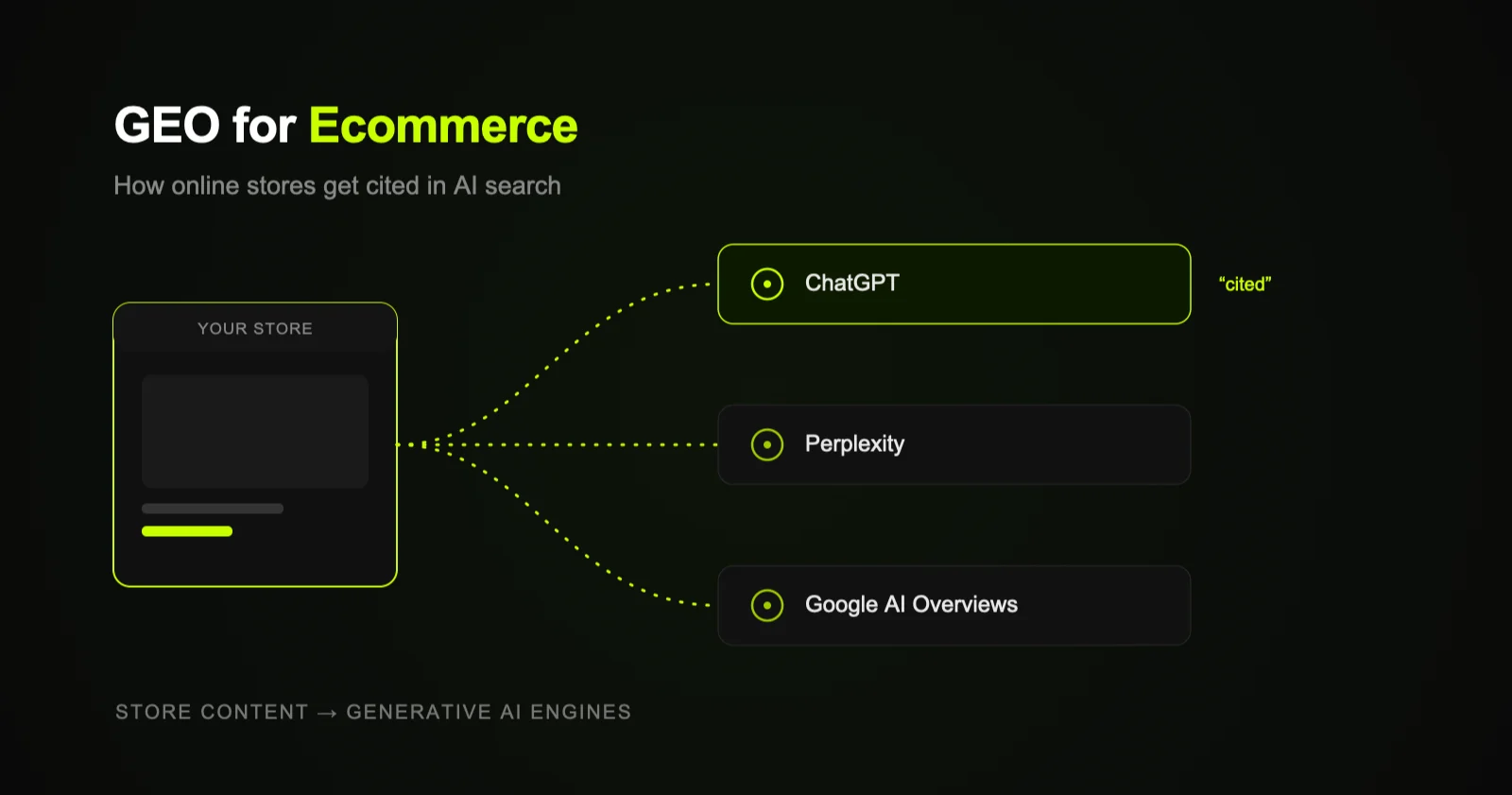
GEO for ecommerce is the practice of making your store and products easy for AI engines — ChatGPT, Perplexity, Google AI Overviews — to understand, trust, and cite when shoppers ask for recommendations. It extends SEO into generated answers, leaning on entity signals, structured data, reviews, and answer-ready content.
Search is splitting into two surfaces. There's the familiar list of blue links, and there's the growing world of AI-generated answers, where a shopper asks a question and gets a synthesized recommendation — often without clicking through to any store. Generative engine optimization (GEO) is how you stay visible on that second surface. For ecommerce, it's quickly becoming its own discipline.
What GEO for ecommerce actually means
GEO is the work of getting your brand and products referenced inside AI answers. Where classic SEO tries to rank a page in a list, GEO tries to make your store the source an AI engine quotes when it builds a recommendation. The two share a foundation — crawlable, fast, well-structured pages — but GEO adds a layer focused on how machines extract and trust information.
For an online store, that means a product isn't just competing for position 1; it's competing to be the item an assistant names when someone asks "what's a good option for X?" If you've read how to get your products recommended by ChatGPT and AI Overviews, GEO is the strategy that sits underneath those tactics.
Why ecommerce needs its own GEO approach
Stores have characteristics that make GEO different from optimizing a blog or a service site:
- Lots of near-identical pages. Large catalogs and duplicate manufacturer copy make it hard for AI to tell why your product is worth citing. (More in why Shopify product pages don't rank.)
- Structured data is central. Price, availability, ratings, and specs are exactly what AI engines want to extract — so clean product schema matters more here than almost anywhere.
- Reviews are a trust currency. Genuine review signals tell an engine your product is real, popular, and well-regarded.
- Brand recognition matters. An unknown store competes against marketplaces; being a clear, recognizable entity is what earns a citation.
The signals AI engines use to cite stores
No engine publishes a formula, but consistent themes show up across how they behave:
- Entity clarity — the engine can confidently say who your brand is, what you sell, and why you're credible.
- Structured product data — valid Product, Offer, Review, and AggregateRating markup, covered in depth in product schema for AI search.
- Answer-ready content — comparisons, buying guides, and FAQs phrased the way shoppers actually ask.
- Trust and review signals — real ratings, mentions on reputable sources, and consistent information across the web.
- Technical accessibility — pages that AI crawlers can reach and parse, with a clean foundation. See technical SEO.
The shift in one line: SEO earns a place in the list; GEO earns a place in the answer. For stores, the answer is increasingly where the shopper decides — so being citable is becoming as important as being rankable.
A GEO-for-ecommerce checklist
- Make your brand a clear entity: consistent name, description, and details across your site and profiles.
- Write unique, specific product and collection content — use cases, who it's for, comparisons.
- Implement and validate Product/Offer/Review/AggregateRating schema across the catalog.
- Build comparison and "best X for Y" content that AI engines can summarize and cite.
- Earn and surface genuine reviews; keep facts consistent everywhere they appear.
- Keep the store technically clean and fast so crawlers can actually read it.
- Test by asking the engines your customers' questions — and track where you appear.
How a store's content becomes an AI citation
flowchart LR
    STORE([Your store
    products + content]) --> SIG{GEO signals}
    SIG --> E[Entity clarity]
    SIG --> S[Product schema]
    SIG --> R[Reviews & trust]
    SIG --> C[Answer-ready content]
    E & S & R & C --> AI[AI engines read
    & evaluate]
    AI --> CITE([Cited in ChatGPT,
    Perplexity, AI Overviews])
    style STORE fill:#111,stroke:#C8FF00,color:#E8E8E8
    style AI fill:#1a1a1a,stroke:#C8FF00,color:#E8E8E8
    style CITE fill:#1a2800,stroke:#C8FF00,color:#C8FF00
    style SIG fill:#0d0d0d,stroke:#C8FF00,color:#E8E8E8
Where to start
GEO isn't a separate project bolted onto SEO — it's the same foundation with an AI-aware layer on top. Start by fixing the basics every engine relies on (clean structure, unique content, valid schema), then build the entity and answer-ready content that make your store quotable. If you want a store-specific plan that covers both classic search and AI citations, that's exactly what Shopify SEO and GEO services are built to deliver.