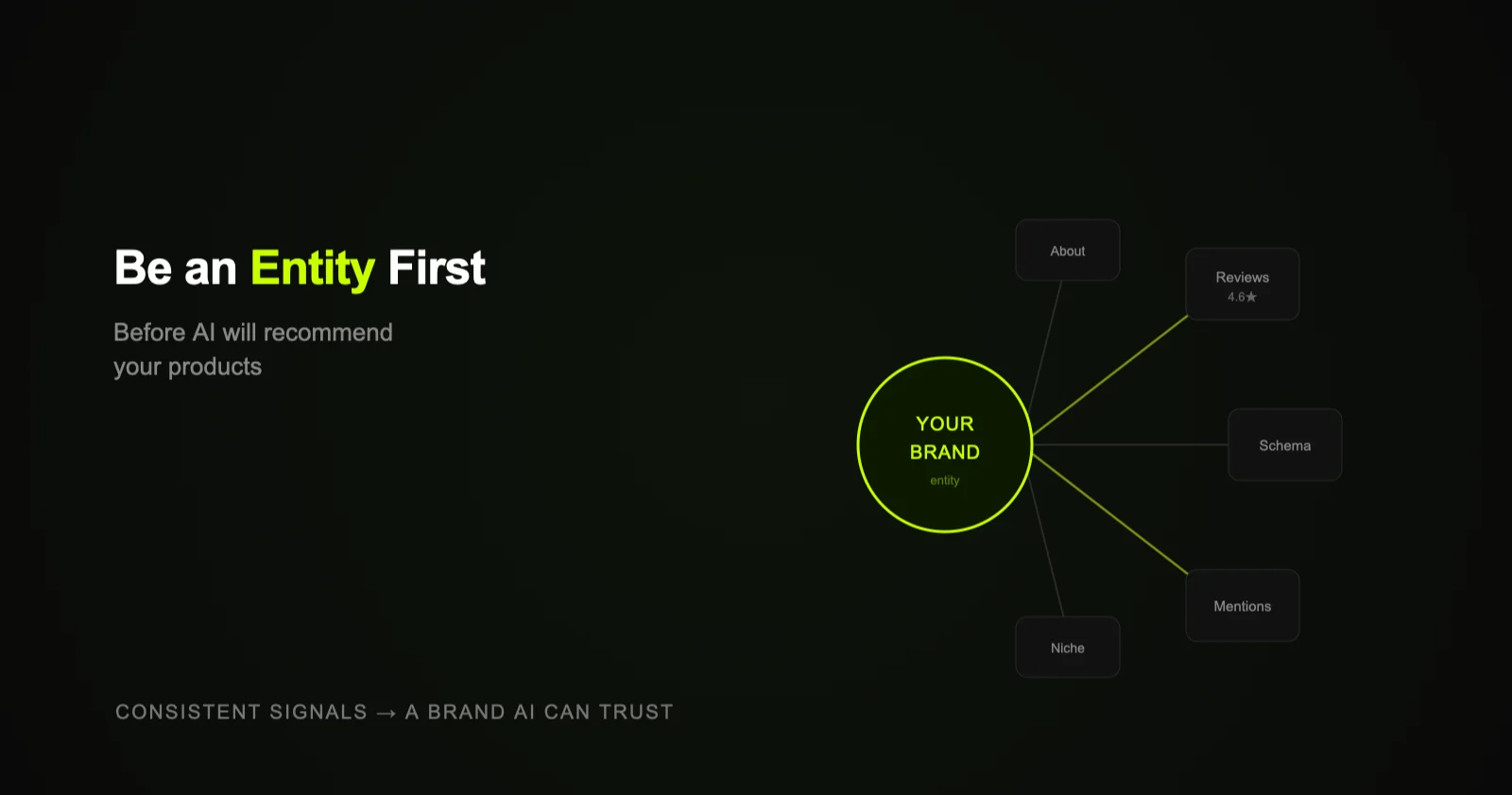
AI engines recommend brands they can confidently understand and trust. If your store isn't a clear entity — a recognized name with a defined identity, products, and reputation — the engine can't be sure who you are, so it defaults to marketplaces and known names. Becoming an entity is the prerequisite for getting recommended.
Here's a frustrating pattern DTC founders run into: you ask ChatGPT or Google's AI for "the best [your product category]," and it names Amazon, a couple of big brands, and maybe a magazine round-up — but never your store, even though your product is genuinely excellent. The problem usually isn't quality. It's that the AI doesn't know your brand exists as a distinct, trustworthy thing. In other words, you're not yet an entity.
What "entity" actually means
An entity is something a machine can identify as a specific, real thing — not just a string of text, but a known node with attributes and relationships. "Nike" is an entity: search engines and AI know it's a brand, what it sells, where it operates, and how it's regarded. A new DTC store with a generic name and a thin footprint is just a page — easy to overlook, impossible to vouch for.
This is the foundation underneath GEO for ecommerce: before an engine can cite your products, it has to be confident about who you are. Entity recognition is that confidence.
Why AI needs an entity before it recommends you
Recommendation is a trust decision. When an AI engine names a product, it's putting its credibility behind that answer, so it favors sources it can verify. If your brand is ambiguous — inconsistent details, no reputable mentions, no clear identity — the safe choice for the engine is to recommend something it's sure about. Three things follow from this:
- Ambiguity is disqualifying. If the engine can't tell whether two mentions of your brand are the same company, it discounts both.
- Recognition compounds. The more consistently you appear across trusted places, the more confidently you're cited.
- Size isn't everything — clarity is. A small, sharply defined brand can beat a bigger but blurry one for a specific query.
The mindset shift: stop thinking only "how do I rank this page?" and start asking "does the web clearly and consistently say who my brand is?" The second question is what unlocks AI recommendations.
The signals that build brand entity
- Consistency everywhere. Identical brand name, description, and details across your site, profiles, and listings. Inconsistency is the fastest way to stay ambiguous.
- Organization schema + a real About page. Tell engines explicitly who you are, what you sell, and how to verify it. This pairs with strong product schema.
- Reputable mentions. Being referenced on credible third-party sources — press, round-ups, directories — is external proof you exist and matter.
- Genuine reviews. Real ratings tie reputation to your name and signal that customers know you.
- Niche-defining content. Unique content that clearly associates your brand with a specific category helps engines slot you into the right answers.
How a brand becomes a recommendable entity
flowchart TD
    B([Your brand]) --> C[Consistent name
    & details everywhere]
    B --> O[Organization schema
    + About page]
    B --> M[Reputable
    third-party mentions]
    B --> R[Genuine reviews]
    C & O & M & R --> KG{Recognized
    as an entity}
    KG --> AI([AI confidently
    recommends you])
    style B fill:#111,stroke:#C8FF00,color:#E8E8E8
    style KG fill:#1a1a1a,stroke:#C8FF00,color:#E8E8E8
    style AI fill:#1a2800,stroke:#C8FF00,color:#C8FF00
How small brands win on focus
You won't out-scale Amazon, and you don't need to. AI recommendations get more specific as shoppers' questions get more specific — "best merino base layer for ultralight backpacking" is a query a focused brand can own far more easily than "best clothes." A tightly defined entity in a real niche is exactly what an engine reaches for when the generic answer won't do. Define your niche clearly, and be the brand the web unambiguously associates with it.
Where to start
Audit how the web currently describes your brand: is the name, story, and category consistent everywhere? Add Organization schema and a substantive About page, fix inconsistencies, earn a few credible mentions, and surface real reviews. That's the groundwork that turns an anonymous store into a brand AI can recommend. If you want this built deliberately, it's a core part of Shopify SEO, GEO services, and AI SEO services.