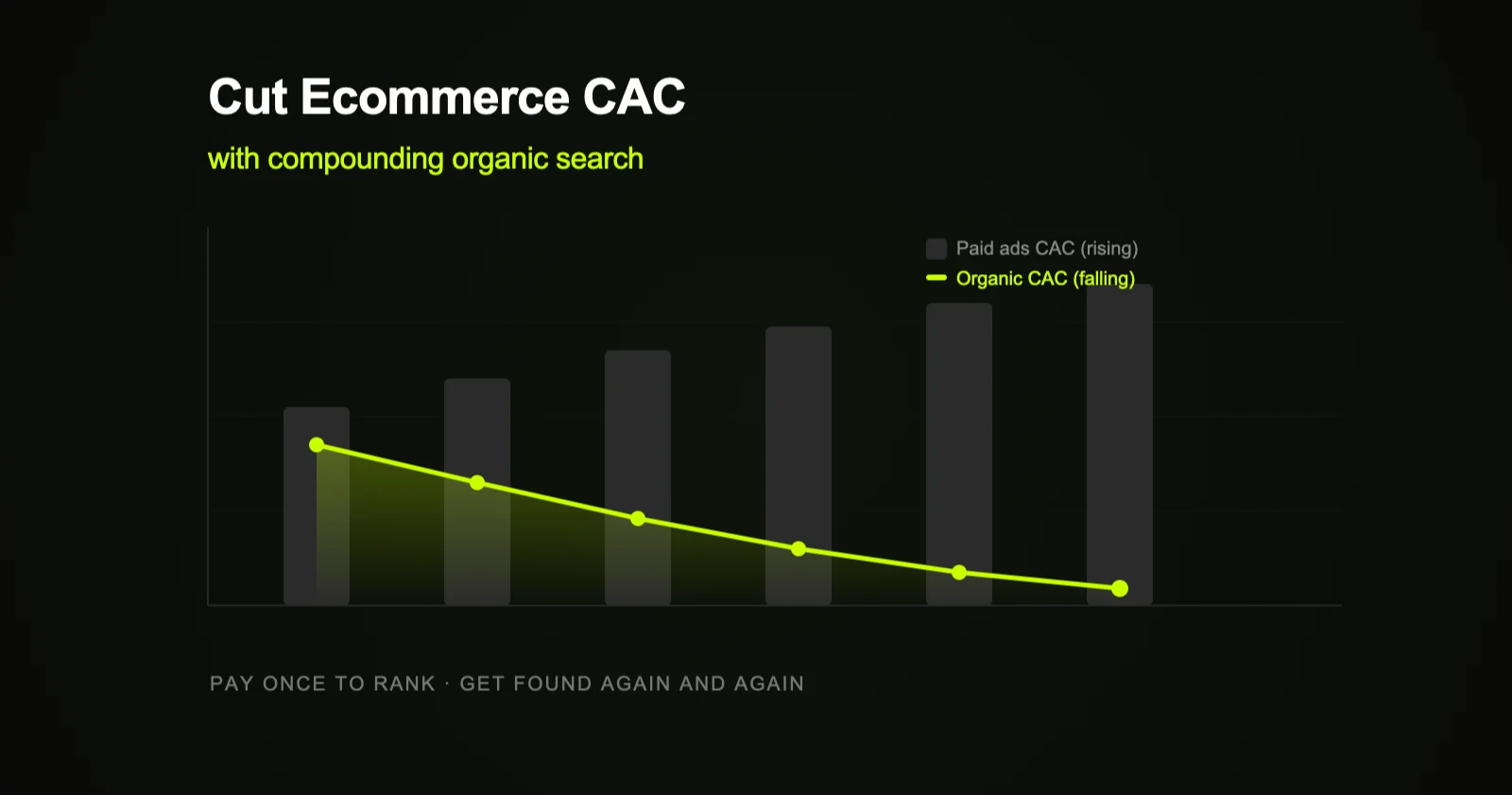
Paid ads charge you for every single click; organic search keeps sending shoppers long after the work is done. By ranking for buying-intent keywords and earning AI citations, ecommerce brands build a compounding channel that steadily lowers customer acquisition cost (CAC) and reduces dependence on rising Meta and Google ad prices.
If you run an ecommerce store, you've felt it: the cost to acquire a customer through paid ads keeps climbing. Meta and Google auctions get more crowded, iOS privacy changes blunted targeting, and every competitor is bidding on the same audiences. You're spending more to stand still — and the moment you pause spend, the sales stop.
Organic search is the antidote to that treadmill. Not a replacement you flip to overnight, but a parallel channel that compounds and quietly blends down your overall acquisition cost. Here's how it works and how to build it.
Why paid CAC keeps rising
Paid acquisition is a rented audience. Every visitor is a fresh transaction: you pay, they click, and if they don't convert, the money's gone. Because ad inventory is auctioned, costs rise as more advertisers compete — and you have no equity to show for past spend. Your CAC is only ever as good as your current campaign, and it resets every month.
That's a fragile foundation for a brand. When ad costs spike or an account gets restricted, revenue can fall off a cliff with nothing underneath it.
How organic search lowers CAC
SEO works the opposite way: it's an asset, not a rental. A collection page that ranks for a buying-intent term, or a product that gets cited in an AI answer, keeps sending qualified shoppers month after month at no incremental cost per click. The upfront investment is real, but the cost per acquired customer keeps dropping as that traffic compounds.
- No per-click charge. Once you rank, additional visitors are essentially free — the marginal CAC trends toward zero.
- Compounding, not resetting. Content and authority you build this quarter keep working next year. Paid spend has to be renewed every day.
- Higher intent. Someone searching "best waterproof hiking boots for wide feet" is closer to buying than someone scrolling a feed — organic captures demand at the moment it exists.
- A second discovery surface. As shoppers ask AI assistants for recommendations, being cited becomes a new, unpaid acquisition channel. More on that in how AI shopping assistants are reshaping ecommerce traffic.
The math that matters: blended CAC. You don't abandon paid — you let organic carry a growing share of acquisition so your average cost per customer falls, even while paid stays flat. That's how stores protect margin without cutting growth.
Where ecommerce SEO actually moves the needle
1. Collection pages built to rank
Category and collection pages capture high-intent, mid-funnel demand ("women's merino base layers") and are your real money pages. Optimizing them — content, internal links, schema — often delivers the fastest organic CAC wins.
2. Product pages that don't cannibalize or duplicate
Thin or duplicate product content keeps stores invisible. Fixing it is foundational; see why Shopify product pages don't rank for the specifics.
3. Technical health
Crawl waste, slow pages, and broken canonicals cap your ceiling no matter how good the content is. A clean foundation — covered under technical SEO — lets everything else rank.
4. Content that earns links and citations
Buying guides, comparisons, and genuinely useful answers attract links and get quoted by AI engines, building the authority that makes the rest of your catalog rank.
Paid vs organic: cost per customer over time
flowchart LR
    subgraph PAID[Paid ads]
      direction TB
      P1[Pay per click] --> P2[Traffic stops
      when spend stops] --> P3[CAC stays high
      / rises]
    end
    subgraph ORGANIC[Organic search]
      direction TB
      O1[Invest upfront] --> O2[Rankings &
      AI citations compound] --> O3[CAC falls
      over time]
    end
    PAID --> BLEND([Run both:
    blended CAC drops])
    ORGANIC --> BLEND
    style PAID fill:#1a1a1a,stroke:#555,color:#888
    style ORGANIC fill:#0d0d0d,stroke:#C8FF00,color:#E8E8E8
    style BLEND fill:#1a2800,stroke:#C8FF00,color:#C8FF00
    style O3 fill:#1a2800,stroke:#C8FF00,color:#C8FF00
How to start without risking revenue
Don't pause paid and pray — that just trades one problem for another. Keep your profitable campaigns running, and build SEO underneath them:
- Fix technical foundations so your store can rank at all.
- Optimize your highest-intent collection and product pages first.
- Add buying-guide and comparison content that earns links and AI citations.
- Track blended CAC monthly, and shift budget away from your most expensive paid campaigns as organic grows.
Done consistently, organic becomes the channel that lowers your cost to acquire each customer and gives your brand a moat that ad budgets can't buy. If you want a store-specific plan, that's exactly what Shopify SEO and broader SEO services are built to deliver.