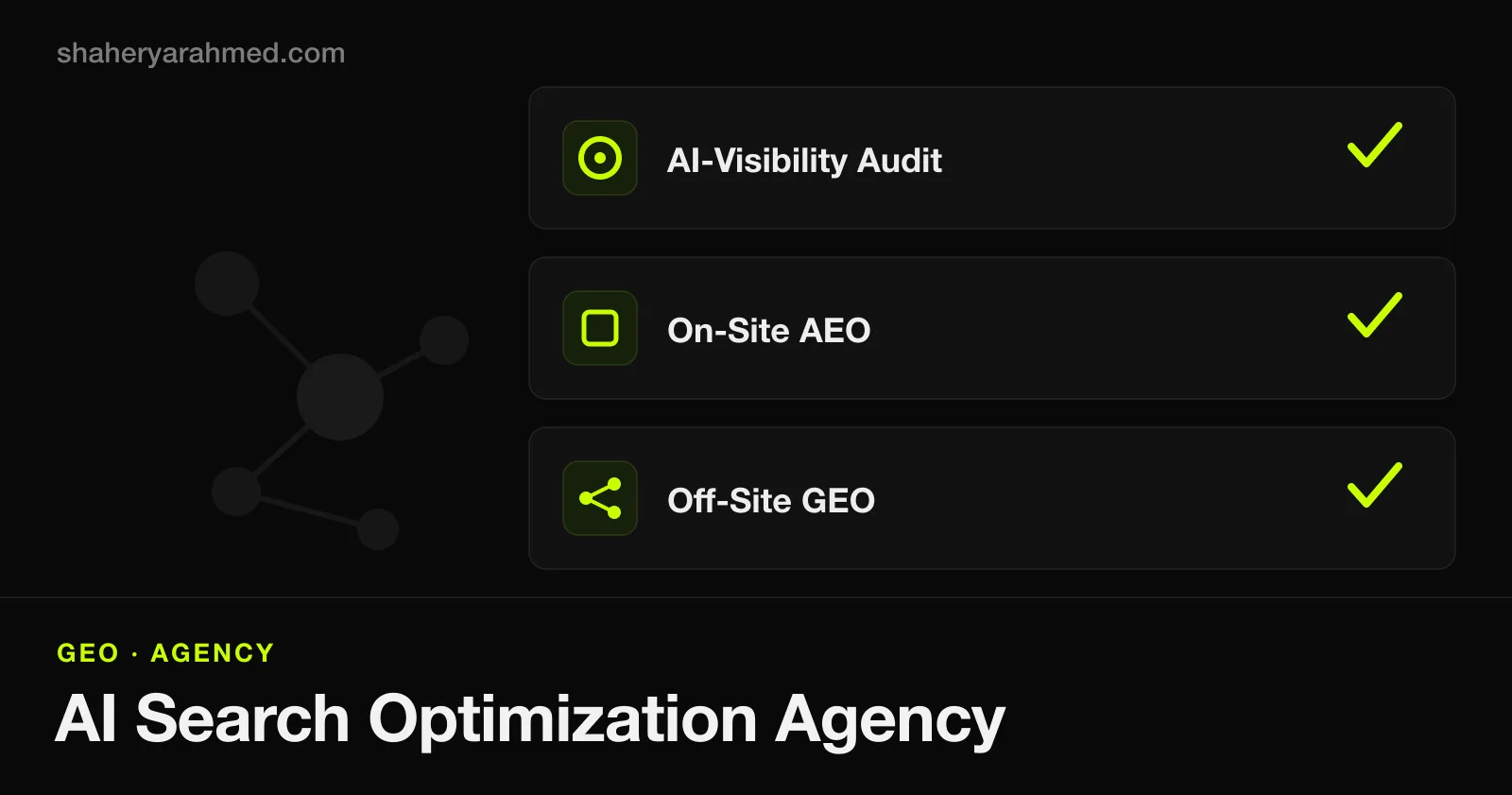
A generative AI search engine optimization agency gets your brand cited inside AI answers — ChatGPT, Perplexity, Google AI Overviews, Copilot, and Gemini. It earns those citations with citable content, entity and schema signals, and third-party corroboration, then reports your share of voice. Expect strategy, execution, and measurement — not just a dashboard.
Key takeaways
- A generative AI search engine optimization agency (also called an AI search optimization agency or AEO agency) exists to get you named by AI answer engines — not to rank blue links.
- Real deliverables: an AI-visibility audit, citable content, entity and schema fixes, off-site corroboration, and monthly share-of-voice reporting. Anything less is a dashboard subscription with a markup.
- Choose on proof, not promises — ask for a real result, a clear scope, and the specific engines they'll move you in.
- Agency vs. consultant vs. in-house comes down to how much you want done for you versus built by you.
- Red flags: guaranteed rankings, no measurement, and "AI SEO" that's just old link-building in a new hoodie.
- I run this as a boutique, done-for-you service — and white-label it for agencies who want to resell it. Start with a free AI-visibility audit.
What does a generative AI search engine optimization agency actually do?
Short version: it makes AI recommend you.
When someone asks ChatGPT "who's the best provider for X near me," an answer comes back naming a handful of companies. A generative AI search engine optimization agency's whole job is to get you into that shortlist — and to do it across every engine your buyers use. This discipline has a few names (AEO, GEO, "AI search optimization"), but the work is the same: engineer the signals AI models rely on when they decide who to cite.
If you want the category defined properly, I wrote a full explainer on what generative engine optimization is. Here, let's stay practical — the actual work breaks into three buckets.
Strategy and measurement. It starts with an audit: which prompts matter, whether AI names you today, and who it names instead. You can't move a number you haven't baselined.
On-site optimization (AEO). Direct-answer content structured the way models quote it, FAQ and entity schema, an llms.txt file, clean technical foundations — the citable assets an engine can lift into an answer.
Off-site corroboration (GEO). AI trusts brands the wider web agrees on. That means consistent entity data, third-party mentions, reviews, and the presence in training and retrieval sources that turns you from unknown into "recommended."
What deliverables should you expect?
If an agency can't map its work to concrete deliverables, keep walking. Here's the baseline I'd hold any AI search optimization agency to:
| Deliverable | What it means | Why it matters |
|---|---|---|
| AI-visibility audit | Baseline of where you're cited (and missing) across ChatGPT, Perplexity, AI Overviews, Copilot | You can't improve what you never measured |
| Citable content | Direct-answer pages structured for AI extraction | This is what engines actually quote |
| Entity + schema work | Consistent identity data, Organization/Person schema, llms.txt | Tells AI who you are and that you're trustworthy |
| Off-site corroboration | Third-party mentions, reviews, directory consistency | AI trusts what the web agrees on |
| Monthly reporting | Share of voice, mention rate, answer position over time | Proves the number moved, not just moved around |
Notice what's not on that list: guaranteed rankings. No one controls a language model's output, and any agency that promises a fixed position is selling you a story.
Agency vs. consultant vs. in-house: which do you need?
There's no universally right answer — only the right fit for your team's bandwidth and budget.
| Option | Best for | Trade-off |
|---|---|---|
| Agency (done-for-you) | You want it handled end to end, reported back monthly | Higher spend, but zero lift on your side |
| Consultant / boutique | You want senior, hands-on work without agency overhead | Capacity is finite — the good ones book out |
| In-house | You have a marketing team to execute against a plan | Steep learning curve; the field moves monthly |
Plenty of buyers frame this as agency vs. consultant and get stuck on the label. It matters less than the model. The real question is whether the work gets done for you or taught to you — and whether whoever does it can show a result.
I run the boutique version on purpose. You get a senior practitioner doing the work, not an account manager relaying it to a junior. For a Southeast moving company, a full engagement grew Search Console impressions from 20,300 to 88,700, clicks from 573 to 965 (+68%), and organic traffic 312% overall, at 4.2× Google Ads ROAS. For a separate D2C apparel brand, Microsoft Copilot citations went from 174 to over 2,100 in a three-month window. Both engagements, including the metrics that moved the wrong way, are documented on the case studies page. That is the kind of movement that comes from the work being done, not delegated down a chain.
How the engagement actually flows
How a GEO agency engagement flows
flowchart TD
    A[AI-visibility audit] --> B{Where are you cited today?}
    B -->|Invisible / weak| C[Fix on-site: citable content + schema + llms.txt]
    B -->|Named but low share| D[Build off-site: entity consistency + corroboration]
    C --> E[Monthly share-of-voice reporting]
    D --> E
    E --> F{Number moving?}
    F -->|Yes| G[Scale to more engines + prompts]
    F -->|Not yet| B
    style A fill:#1a1a1a,stroke:#C8FF00,color:#E8E8E8
    style G fill:#1a2800,stroke:#C8FF00,color:#C8FF00
The loop matters more than any single tactic. AI visibility rewards a cadence — audit, optimize, measure, repeat — not a one-time project.
How do you choose the right one? (And the red flags)
Vet any agency that specializes in AI search optimization on five things:
- Proof, not adjectives. Ask for one real result on one real client. "We're experts in AI" is not proof.
- Named engines. Which ones will they move you in — ChatGPT, Perplexity, AI Overviews, Copilot, Gemini? Vague answers mean vague work.
- A measurement layer. They should track share of voice with a tool. If you're comparing options, my roundup of the best AI search optimization software shows what that reporting looks like.
- Both halves. On-site AEO and off-site GEO. Agencies that only tune your pages ignore the corroboration signals that actually earn trust.
- Transparent scope and price. You should know exactly what you're buying and roughly what it costs before you sign.
The red flags are the mirror image: guaranteed #1 in AI answers, no reporting, month-to-month "SEO" rebranded as AI with nothing new underneath, and account teams three layers removed from the actual work. If it smells like 2015 link-building with a 2026 label, it is.
The white-label angle (for agencies)
Not every reader is the end client. If you already run a marketing agency and your customers are asking about AI visibility, you don't have to build the capability from scratch. I white-label this service — you keep the client relationship and the brand, I do the AEO/GEO work behind the scenes. That's the whole point of white-label SEO and GEO: sell the outcome, skip the hiring. It's how a lot of the AI marketing agencies specializing in AI search optimization actually deliver — quietly, through a specialist partner.
Get a baseline before you hire anyone — free
Before you pay any generative AI search engine optimization agency a retainer, find out where you actually stand. Grab a free AI-visibility audit and I'll show you exactly where ChatGPT, Perplexity, and AI Overviews mention you today, where you're invisible, and which competitors are getting cited instead.
If you'd rather have it handled, book a free 30-minute strategy call and I'll map the done-for-you path — the same AEO/GEO consulting work behind +68% click growth and 2,100+ Copilot mentions for a client. Measurement tells you the score. This is how you change it.
In short: a generative AI search engine optimization agency earns you citations inside AI answers with strategy, on-site AEO, off-site GEO, and monthly reporting. Choose on proof, insist on both halves of the work, and never accept a guaranteed-ranking promise.