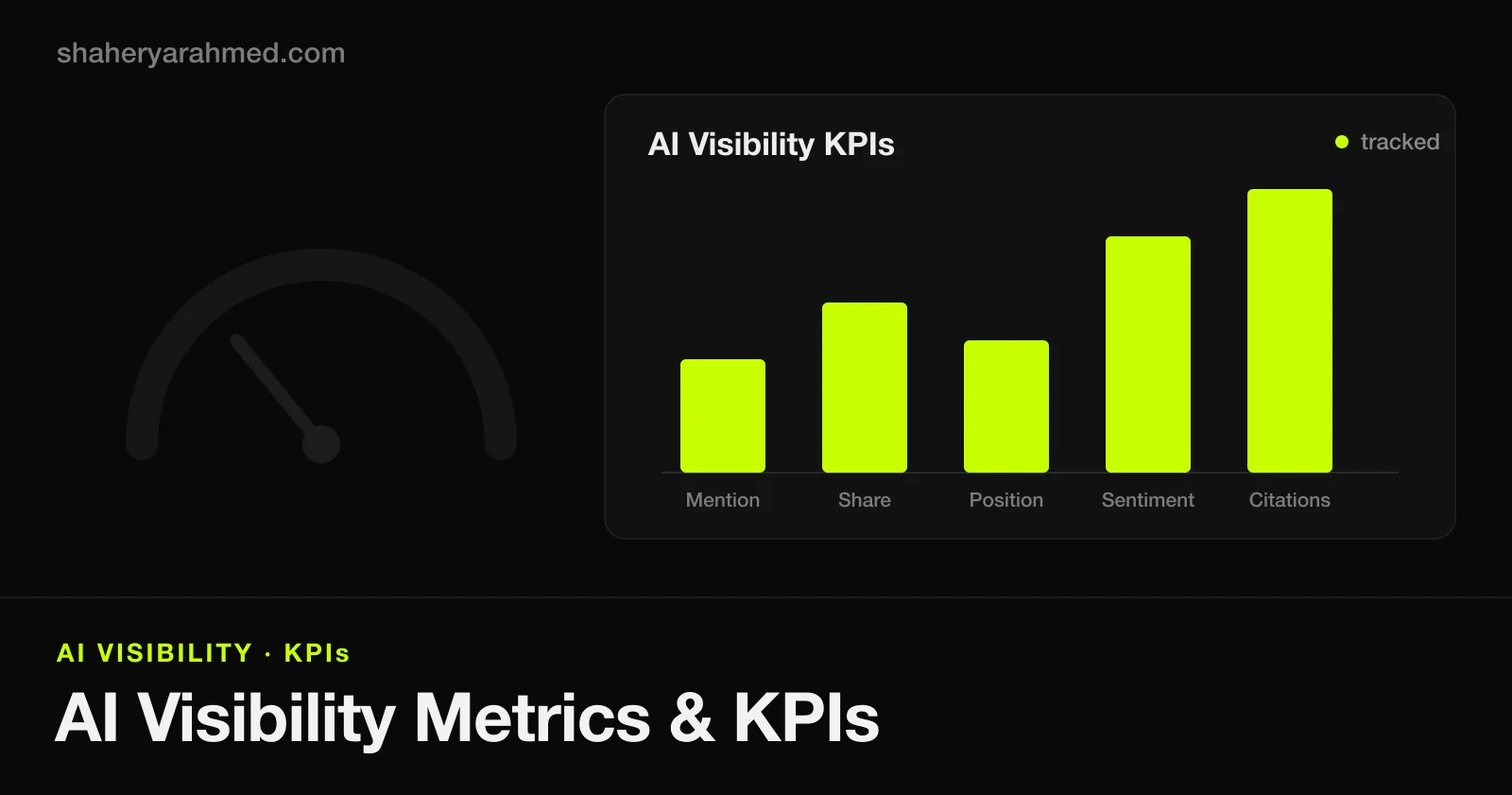
AI search visibility is how often — and how well — AI answer engines like ChatGPT, Perplexity, Google AI Overviews, Copilot, and Gemini name your brand when someone asks a question in your category. The metrics that actually matter are mention rate, share of voice, answer position, sentiment, prompt coverage, citation share, and referral traffic from LLMs. Track those, not vanity scores.
Key takeaways
- AI search visibility measures your presence inside AI-generated answers — a different game from blue-link rankings, and it needs its own KPIs.
- The seven that matter: mention rate, share of voice, answer position, sentiment, prompt coverage, citation share, and LLM referral traffic. Everything else is a proxy for these.
- "Good" isn't a universal number — it's directional: are you named more often, higher up, more positively, and across more prompts than last month, and more than your competitors?
- Yes, keyword strategy still affects visibility in AI search results — but the unit changed from keywords to prompts and entities.
- Tools measure these KPIs. They don't move them. The work that earns citations — citable content, entity signals, corroboration, schema — is separate.
- Want your own numbers? Start with a free AI-visibility audit.
What is AI search visibility?
AI search visibility is the degree to which AI answer engines mention, cite, and recommend your brand when users ask questions in your space. It's the AI-era successor to "where do I rank on Google" — except there's often no page of ten blue links to rank on. There's one synthesized answer, and you're either in it or you're invisible.
That shift is why the old scoreboard breaks. Position #1 on a keyword means little when ChatGPT reads a dozen sources and names three brands in a paragraph, none of which had to rank first. AI search visibility asks a blunter question: when your buyer asks the machine who to trust, does your name come out of it?
I do this measurement for clients every week, and the pattern is consistent — most businesses have never actually looked. They assume that because they rank on Google, AI must be recommending them too. Often it isn't. The two are correlated but not the same, which is exactly why you need dedicated KPIs.
Why do AI search visibility metrics matter in 2026?
Because a growing share of buying research now happens inside an answer engine, and that surface is a black box unless you measure it. Google's AI Overviews, ChatGPT's search, and Perplexity all resolve the question before the user ever reaches a website. If you're not in the answer, you don't get the click — or the consideration.
Traditional analytics won't warn you about this. GA4 shows you traffic that arrived; it can't show you the buyer who asked ChatGPT "who's the best AEO consultant for a Shopify brand," got three names that weren't yours, and never visited. AI search visibility metrics exist to make that invisible loss visible. Without them, you're optimizing for a scoreboard your customers stopped reading.
What are the AI search visibility KPIs that actually matter?
There are seven. Each answers a different question, and together they form a funnel from "are you even in the conversation" down to "did it make money."
1. Mention rate
What it measures: how often you're named across a set of relevant prompts. Run 100 category prompts; if you're named in 22 answers, your mention rate is 22%. This is the foundational AI-visibility number — presence before position.
2. Share of voice
What it measures: your mentions as a percentage of all brand mentions in your category. If you and four competitors get named across a prompt set and you account for a third of the mentions, your share of voice is ~33%. It's the competitive version of mention rate, and it's the metric that tells you whether you're winning or just present.
3. Answer position
What it measures: where in the answer you appear. Named first, in the lead recommendation, carries far more weight than a footnote at the bottom of a long response. Position is to AI answers what rank was to the SERP — order signals authority to the reader.
4. Sentiment
What it measures: how you're described. Being named is necessary but not sufficient — the engine can name you neutrally, glowingly, or with a caveat ("X is affordable but limited"). Sentiment tracks whether your mentions help or quietly hurt.
5. Prompt coverage
What it measures: the breadth of prompts you appear across — informational, commercial, comparison, "near me," "best for X." High mention rate on a narrow slice of prompts is fragile. Wide prompt coverage means you show up across the whole buyer journey, not just one query.
6. Citation share
What it measures: how often your domain is the linked source behind an answer, versus a competitor's or a third-party listicle's. Mentions build brand; citations build authority and can drive the click. This is where AEO structure — citable, quotable content — pays off directly.
7. Referral traffic from LLMs
What it measures: actual sessions arriving from AI engines (ChatGPT, Perplexity, Gemini, Copilot referral sources in GA4). It's the bottom of the funnel — the KPI that connects everything above it to visits, leads, and revenue. Smaller in raw volume than Google today, but the highest-intent traffic most of my clients see.
AI search visibility KPI reference table
Here's the whole scoreboard in one place — bookmark this.
| KPI (metric) | What it measures | How to track it | Why it matters |
|---|---|---|---|
| Mention rate | How often you're named across relevant prompts | AI-visibility tool running a fixed prompt set, sampled repeatedly | Baseline presence — are you in the conversation at all? |
| Share of voice | Your mentions vs. all competitor mentions in the category | Same prompt set, tagged by brand; your % of total | Tells you if you're winning, not just showing up |
| Answer position | Where in the answer you appear (lead vs. footnote) | Manual review or tool that scores placement per response | Order signals authority; first-named wins consideration |
| Sentiment | Whether you're described positively, neutrally, or with caveats | Tool sentiment scoring + manual spot-checks of the language | A negative or hedged mention can cost more than no mention |
| Prompt coverage | Breadth of prompts/journey stages you appear across | Map appearances across an informational→commercial prompt map | Wide coverage = durable visibility across the funnel |
| Citation share | How often your domain is the linked source | Tool citation tracking + AI-referral analysis in server logs | Drives the actual click and compounds domain authority |
| LLM referral traffic | Sessions arriving from AI engines | GA4 / server logs, segmented by AI referral source | The revenue link — connects visibility to real outcomes |
How do the KPIs fit together? (the measurement funnel)
They aren't a flat list — they stack. Prompt coverage sets the field you can be seen on; mention rate and share of voice decide whether you're seen; position and sentiment decide the quality of that visibility; citation share turns it into clicks; referral traffic turns clicks into revenue. Here's the hierarchy I use with clients:
The AI visibility measurement funnel
flowchart TD
    A["Prompt coverage
(the questions you could appear on)"] --> B["Mention rate
(are you named?)"]
    B --> C["Share of voice
(named more than rivals?)"]
    C --> D["Answer position
(named first or last?)"]
    C --> E["Sentiment
(named well or with caveats?)"]
    D --> F["Citation share
(is your domain the source?)"]
    E --> F
    F --> G["LLM referral traffic
(sessions from AI engines)"]
    G --> H["Revenue
(leads, sales, pipeline)"]
    style A fill:#1a1a1a,stroke:#C8FF00,color:#E8E8E8
    style H fill:#1a2800,stroke:#C8FF00,color:#C8FF00
Read it top to bottom and you have a diagnosis tool. High mention rate but low citation share? You're being talked about but not linked — an AEO content problem. Good position but poor sentiment? You're visible but described badly — a messaging and corroboration problem. Each stage tells you where the leak is.
How do you measure each AI visibility KPI?
Three layers, in order of effort and precision.
- Manual prompt testing (free, start here). Write 15–25 real buyer prompts for your category. Ask them in ChatGPT, Perplexity, Gemini, and Copilot. Log whether you're named, where, how, and who beat you. Repeat monthly. It's tedious but it's honest, and it's exactly what my free AI-visibility audit does at a deeper level.
- Dedicated software (scale + trend data). AI visibility platforms run large prompt sets automatically, sample repeatedly to smooth out AI's non-determinism, and chart mention rate, share of voice, sentiment, and citation share over time. I break down the category in best AI search optimization software — pick on data accuracy and engine coverage, not feature count.
- Your own analytics (the revenue layer). Segment GA4 and server logs by AI referral source to capture LLM referral traffic, then tie it to conversions. This is the only KPI you can measure from first-party data alone, and it's the one that closes the loop to money.
A note on ai search visibility management tools: they're excellent at layers 2 and 3 and worthless at moving the number. They report mention rate; they don't earn mentions. Keep that distinction front of mind so you don't confuse a dashboard with a strategy.
What does "good" AI search visibility look like?
There's no universal benchmark yet — the category is too young, and "good" depends entirely on how competitive your niche is. What matters is direction and relative position, measured against two things: your own last-month baseline, and your named competitors.
Practically, healthy looks like this: your mention rate and share of voice trend up month over month; you're increasingly named in the lead position rather than the footnote; sentiment stays positive; prompt coverage widens into new journey stages; and LLM referral traffic in GA4 grows from a trickle into a measurable, converting channel. If those arrows point up against a fixed prompt set, you're winning — regardless of the absolute numbers.
For grounding: For a Southeast moving company, a full engagement grew Search Console impressions from 20,300 to 88,700, clicks from 573 to 965 (+68%), and organic traffic 312% overall, at 4.2× Google Ads ROAS. For a separate D2C apparel brand, Microsoft Copilot citations went from 174 to over 2,100 in a three-month window. Both engagements, including the metrics that moved the wrong way, are documented on the case studies page. The point isn't the raw figures — it's that impressions, clicks, and citations move together when the underlying work is right, and that the ones that dip (position, CTR during an expansion phase) tell you as much as the ones that climb.
Does keyword strategy affect visibility in AI search results?
Yes — but the unit of optimization changed. Keywords still matter as topics and entities; AI engines resolve queries by understanding concepts and the relationships between them, so the entities and language you own still decide which questions you're eligible to appear in. What changed is that a single ranked keyword no longer wins you a spot. You're now optimizing for prompts — full natural-language questions — and for the entity the engine associates with your brand.
So keyword research doesn't die; it evolves into prompt-and-entity mapping. Instead of "rank for AEO consultant," the job is "be the named answer to who's the best AEO consultant for a US Shopify brand." Same intent, richer unit. If you want the deeper mechanics, my primer on what generative engine optimization is and my guide to Google AI Overview optimization both go further.
How do AI search visibility KPIs connect to revenue?
Through the funnel above — each KPI is a leading indicator of the next, and referral traffic is the last stop before money. Rising share of voice means more buyers hear your name during research; better position and sentiment mean more of them trust it; higher citation share and LLM referral traffic mean more of them actually arrive. That's a pipeline, and it's why I treat these as business KPIs, not marketing trivia.
This is also the honest answer to how AI search optimization tools increase organic traffic: they don't, directly. A tracker never wrote a sentence or earned a citation. What increases traffic is acting on what the tool reveals — closing the gaps it exposes with citable content, entity signals, corroboration, and schema, then watching mention rate and referral traffic climb in response. The tool is the thermometer; the optimization is the treatment. If you want to see how the treatment prices out, I laid it out in how much AEO costs.
Measure it before you try to move it
You can't improve what you refuse to look at. Nail down your mention rate, share of voice, answer position, sentiment, prompt coverage, citation share, and LLM referral traffic — then you have a baseline worth optimizing against. Guessing is not a strategy; a scoreboard is.
If you want your real numbers instead of assumptions, grab a free AI-visibility audit and I'll show you exactly where you stand across ChatGPT, Perplexity, Gemini, and Copilot. Ready to move the number, not just track it? See how I work as a GEO & AEO consultant, or get in touch and let's talk about your category.
In short: track mention rate, share of voice, answer position, sentiment, prompt coverage, citation share, and LLM referral traffic against a fixed prompt set — direction beats absolute numbers, and a tool measures these KPIs but doesn't move them.