Position 43 → 26.
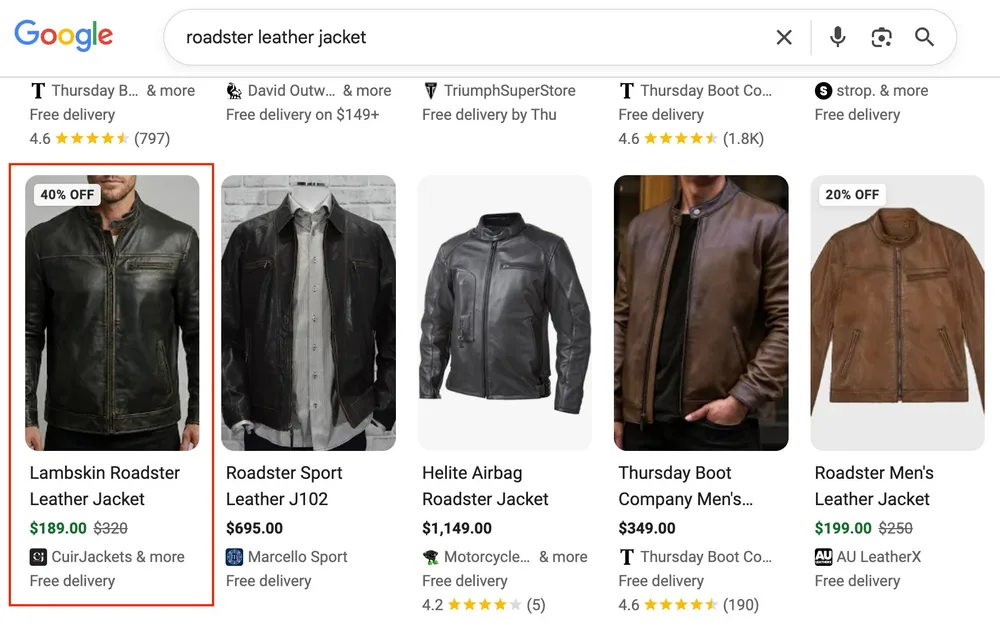
And a #1 Google Shopping listing.
A D2C leather-jacket brand on Shopify. In three months of organic SEO, I moved average position from 43.2 to 26.3, more than doubled impressions, and landed a #1 Google Shopping organic listing — with no ad spend. Every number here comes straight from Google Search Console.
How do you get a #1 Google
Shopping organic listing?
Rebuild the Google Merchant Center feed and the product-page data behind it — keyword-targeted titles, complete product schema, and long-tail keyword targeting. That is how this D2C Shopify store reached a #1 Google Shopping organic listing in three months, with impressions up 134% and no ad spend. Below is exactly what that looked like, with every number pulled from Search Console.
A great product,
invisible to Google.
The store had exactly the problem I see on most Shopify catalogs: strong products Google could barely read. Titles were the raw product names, meta descriptions were auto-generated or blank, image alt text was empty, and the Google Merchant Center feed wasn't clean enough to earn organic Shopping placement. The store was paying for traffic that better-structured product data could win for free.
None of it is exotic — it's the default state of a Shopify store nobody has done deliberate SEO on, and it's fixable. The job was to make every product page something Google can understand, rank, and surface in Shopping, then build the authority to make those rankings hold.
Rebuilt the product data,
then earned the authority.
Product-page SEO, page by page
Keyword-targeted title tags written for what buyers actually search, meta descriptions written to earn the click, product descriptions rewritten with long-tail variations embedded naturally, image alt text on every asset, and product schema so Google can parse the data precisely.
Google Merchant Center feed
Cleaned, completed, and correctly categorized the product feed so the catalog became eligible for Google Shopping organic listings — the free, image-first placements at the top of product searches.
Main + long-tail keyword map
Targeted the head terms for relevance and built a web of lower-competition long-tail queries around them — the specific, higher-intent searches that rank faster and convert better than a broad term like "leather jacket."
Domain authority + internal linking
A targeted guest-posting push on relevant publications to build the off-page authority on-page work needs to actually rank, plus an internal-link structure that routes authority to the product pages that needed it most.
The same playbook runs on every store I take on — it's the core of my Shopify SEO work: make the product data legible to Google, earn the Merchant Center placement, then build authority so the rankings hold.
Every number from
Google Search Console.
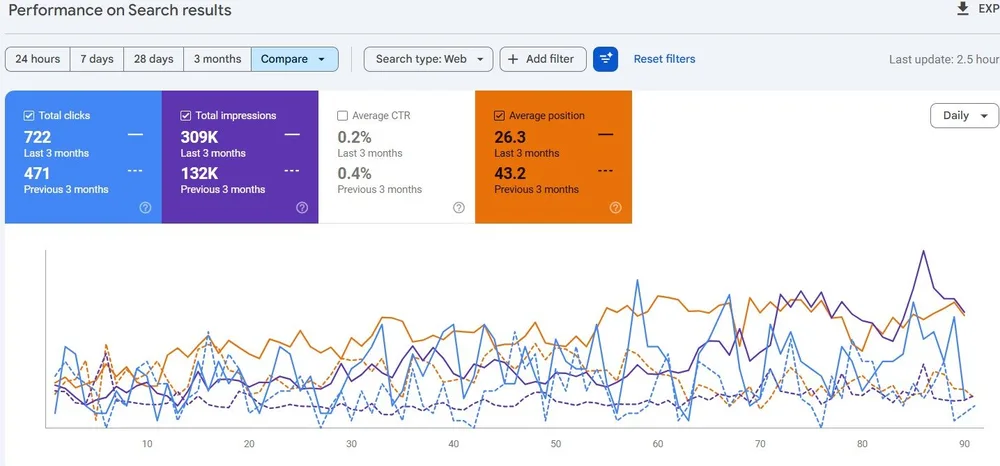
| Metric | Previous 3 months | Last 3 months |
|---|---|---|
| Organic clicks | 471 | 722 |
| Impressions | 132K | 309K |
| Average CTR | 0.4% | 0.2% |
| Average position | 43.2 | 26.3 |
Average CTR dropped from 0.4% to 0.2% over the window — and that's expected here, not something hidden in the averages. Impressions grew 134% while clicks grew 53%, because the store started surfacing for a far wider set of queries where it previously didn't appear at all. Average CTR falls when a page shows up for many more searches; clicks, impressions, and position all moved the right way, and CTR climbs back as those newer rankings mature toward page one.
#1 in Google Shopping —
at zero cost per click.
For the search "roadster leather jacket," the brand's product sits at position one in the Google Shopping organic carousel — the image-first row shoppers see before they click anything. That placement is driven entirely by optimized product data in Google Merchant Center. It's free, high-intent traffic with no ad spend behind it.
Questions about
this case study.
How do you get a #1 Google Shopping organic listing?
How long did these Google Shopping results take?
Were these results organic or paid?
What is a Google Shopping organic listing?
Can you do this for my Shopify store?
Get a free audit of your Shopify store.
No pitch, no automated report — a real review of where your product pages and Merchant Center feed are leaving organic traffic on the table.
Book a free strategy call