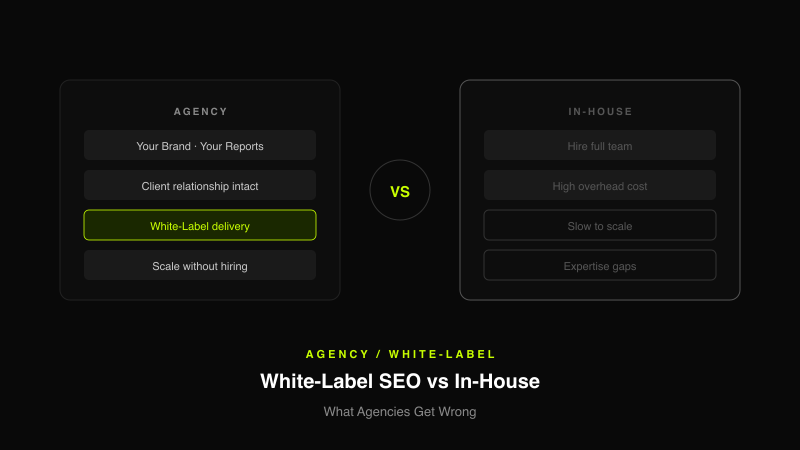
Quick answer: White-label SEO lets an agency deliver SEO under its own brand without hiring a full team, while in-house means building and managing that capability yourself. White-label is usually faster to scale and lower-overhead; in-house offers more control at higher cost.
The conversation I have most often with agency founders goes something like this: they're doing $30–80k/month in revenue, have a handful of web design or PPC clients asking about SEO, and they're trying to decide whether to hire an in-house SEO or white-label the work. They make the wrong call about 60% of the time — and in both directions.
Some hire in-house too early, before they have the client volume to justify the overhead. Others white-label when they're big enough that they're paying margins they don't need to. Here's the framework I use to help agencies make this call correctly.
The Core Trade-Off
In-house SEO gives you control, institutional knowledge, and eventually better margins at scale. White-label SEO gives you speed, flexibility, and the ability to offer a service you don't yet understand without the risk of hiring wrong.
Neither is inherently better. The right answer depends entirely on where your agency is in its lifecycle.
White-Label Wins When...
- You have fewer than 5 active SEO retainers
- SEO is not your agency's core service
- You can't afford 3–6 months of hiring risk
- You need to move fast on a new client
- You want to test SEO before committing
In-House Wins When...
- SEO is your primary or largest service line
- You have 8+ active SEO clients
- Your white-label margins are compressing profits significantly
- You need deep client-specific institutional knowledge
- You're building toward an exit or acquisition
Mistake 1: Treating White-Label as a Stopgap, Not a Model
The most common error I see is agencies treating white-label SEO as a temporary bridge to eventual in-house hiring. They sign on a white-label provider with the mental framing of "until we can afford to hire."
This creates two problems. First, they don't invest properly in the white-label relationship — they don't share client context, don't align on strategy, and don't push back on deliverables — so results suffer. Second, they benchmark success against a future in-house hire that may never make financial sense.
Some agencies run exceptionally profitable businesses on a fully white-label model indefinitely. The agency owns client relationships, strategy, and account management. The white-label partner owns execution. Margins of 40–60% on SEO retainers are achievable and sustainable.
Mistake 2: The Hidden Cost of In-House Hiring
Agencies that decide to hire in-house typically underestimate the full cost. The visible cost is salary — typically $55–85k/year for a competent SEO in the US. The invisible costs add 40–60% on top:
- Employer taxes and benefits: +20–30%
- SEO tools (Ahrefs, Semrush, Screaming Frog, etc.): $500–1,500/month
- Onboarding time: 4–8 weeks before meaningful output
- Management overhead: 3–5 hours per week of director/founder time
- Hiring risk: 30–40% of hires underperform and require replacement
A $70k SEO hire realistically costs $95–100k all-in before they're producing consistently. That requires roughly $12–15k/month in SEO retainer revenue just to break even — which means you need 4–6 solid clients before the math works.
Mistake 3: White-Label Is "Just Reselling Someone Else's Work"
Agencies that dismiss white-label as ethically problematic or strategically weak miss the point. Your clients are buying your relationship, your strategic layer, and your accountability — not the technical execution of keyword research. Every professional services firm uses subcontractors and specialists. Lawyers do it. Architects do it. Ad agencies do it constantly.
The value you provide is identifying the right strategy, communicating it clearly to the client, ensuring quality of execution, and being accountable when things don't go to plan. A good white-label partner handles the part of the work that doesn't require your client relationship.
Mistake 4: Choosing the Wrong White-Label Partner
The quality gap between white-label providers is enormous. At the bottom end are link farms and content mills producing work that damages client sites. At the top end are specialist consultants who produce the same quality output you'd get from a strong in-house hire — just without the overhead.
What to look for in a white-label SEO partner:
- Transparent methodology — they should be able to explain what they do and why
- References from other agency clients
- Case studies with verifiable traffic data
- Clear communication cadence and reporting format
- Willingness to join client calls under your brand
- No black-hat tactics (PBNs, link schemes, keyword stuffing)
Price is not a reliable quality signal. I've seen $300/month packages and $3,000/month packages both fail. Methodology is the signal.
The Hybrid Model: Best of Both Worlds
The agencies I see with the strongest SEO margins typically run a hybrid model: one in-house SEO strategist who owns client relationships and strategy, plus a white-label execution partner for the labour-intensive deliverables (content, link outreach, technical fixes).
This gives them the institutional knowledge and client trust of in-house, with the cost flexibility and scalability of white-label. The in-house person costs $70–90k. The white-label execution happens at predictable per-unit costs that scale with revenue rather than requiring fixed headcount additions.
What This Means for Your Agency Right Now
If you're under $500k ARR and SEO isn't your primary service: white-label is almost certainly the right call. Focus your capital on what you're best at and let a specialist handle SEO execution.
If you're between $500k and $2M ARR and SEO represents 30%+ of revenue: start thinking about the hybrid model. One strong in-house strategist plus white-label execution is your inflection point.
If you're over $2M ARR with SEO as your core service: in-house teams make financial and strategic sense. You have the volume to justify it and the brand risk to make quality control critical.
I offer white-label SEO services for agencies that want a partner they can trust to represent their brand. Every deliverable is rebrandable, and I'm happy to join client calls under your agency name. Let's talk about what your clients need.