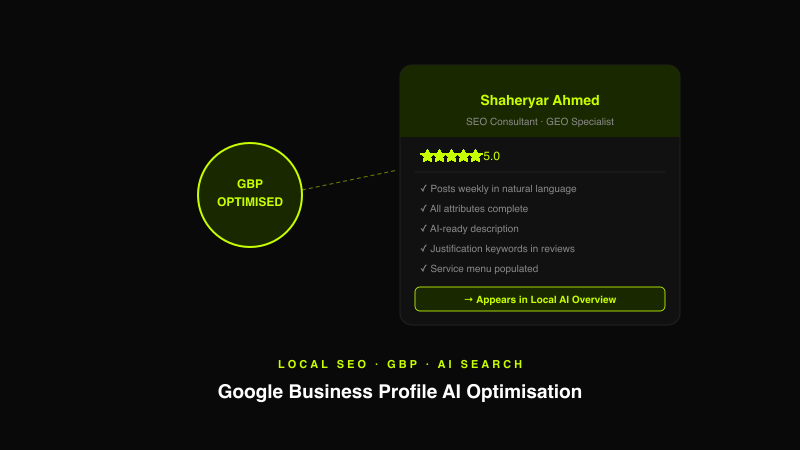
Quick answer: To optimise Google Business Profile for AI search, complete every field, populate categories and services, post regularly, earn reviews that mention your services, and keep your information consistent — these signals feed local rankings and local AI answers.
Google Business Profile (GBP) is no longer just a listing. In 2026, it's a primary data source for Google's local AI Overviews, local Knowledge Panels, and the conversational AI features in Google Maps. A fully optimised GBP is one of the highest-ROI local SEO investments available — particularly for businesses targeting specific cities and neighbourhoods.
Most businesses set up their GBP profile once and forget it. The businesses appearing in local AI Overviews and Maps AI features are the ones treating GBP like an active content channel.
How Google Uses GBP Data in AI Systems
Google's local AI Overviews pull from three primary sources: your website's LocalBusiness schema, your GBP profile, and third-party review signals. When all three are consistent and rich with relevant data, the AI confidence in your entity is high enough to cite you. When one or more of these signals is thin or inconsistent, you get passed over for a competitor whose data is cleaner.
The key insight from my local client work in 2026: GBP attributes are entity signals, not just UX features. When you fill in "payment methods," "accessibility features," and "service-specific details," you're not just helping customers — you're enriching Google's entity graph with structured data about your business.
The 7 GBP Optimisations That Actually Move the Needle
1. Justification-optimised review management
Google's local search often shows "justifications" — excerpts from reviews that explain why a business matches a specific query. These appear as snippets beneath the business name and directly influence AI citation decisions. To earn justifications, you need reviews that contain specific service keywords.
The tactic: after completing a project, send clients a follow-up message that says something like "If you were happy with our local SEO work, we'd really appreciate a Google review mentioning the specific services we provided." This isn't review manipulation — it's directing authentic feedback toward keyword-rich descriptions.
2. Complete every attribute category
GBP has dozens of attribute categories — many of which most businesses leave blank. In 2026, every completed attribute is a structured data signal feeding Google's entity graph. Log into your GBP, navigate to the "Info" and "More" sections, and systematically complete every applicable attribute: service area, service options, highlights, accessibility, planning, and service-specific attributes for your category.
3. Build your Products and Services section
The Products and Services section of GBP is significantly underused. Each service you list becomes a structured data entry in Google's local graph. List every distinct service with a name, description (100–200 words), price range (if applicable), and a link to the relevant service page. This section directly feeds "justification" eligibility for service-specific queries.
4. Post weekly using conversational, AI-ready language
GBP posts are indexed by Google and used as freshness signals. Post weekly — not occasionally. Each post should be written in the same conversational, direct language that works for AEO: clear topic sentence, specific information, and a direct CTA. Avoid generic filler ("Excited to announce...") and lead with the specific, useful information.
5. Answer every question in the Q&A section
The Q&A section of GBP feeds directly into conversational AI features. When users ask Google Maps "does this business do X?" the AI pulls from the Q&A section to answer. Pre-populate it yourself by asking and answering the 10–15 most common questions about your business. This is AEO for your GBP.
6. Maintain consistent NAP across all citations
Name, Address, Phone (NAP) consistency across your GBP, website, and third-party directories is a local entity corroboration signal. Inconsistencies — "Suite 100" vs "Ste 100," or different phone formats — create entity resolution uncertainty. Audit your top 20 directory citations quarterly and standardise.
7. Upload geo-tagged photos regularly
Photos with EXIF location data confirm your geographic entity association. Add 3–5 photos per month — team photos, workspace images, project results — ensuring they are geotagged to your business location. Businesses with more photos consistently outperform those without in local pack visibility.
From client work: The single highest-impact GBP change I've seen for local AI Overview visibility is completing the Products/Services section in full. Businesses that do this correctly regularly appear in local AI Overviews within 4–8 weeks, even without changing anything else.
I include GBP optimisation as part of local SEO engagements across California and other US markets. If you want a full audit of your GBP and local entity signals, book a free strategy call.
GBP Optimisation → Local AI Overview Citation Flow
flowchart LR
    subgraph GBP["Google Business Profile"]
        G1[Complete attributes] --> G2[Products & Services
section]
        G2 --> G3[Weekly posts]
        G3 --> G4[Q&A pre-populated]
        G4 --> G5[Review justifications]
        G5 --> G6[Geo-tagged photos]
    end
    subgraph Signals["Entity Signals to Google"]
        S1[Structured local
entity data]
        S2[Freshness signals]
        S3[Conversational
AI content]
        S4[Social proof
with keywords]
    end
    G1 --> S1
    G3 --> S2
    G4 --> S3
    G5 --> S4
    S1 & S2 & S3 & S4 --> R([Local AI Overview
citation])

    style GBP fill:#0d0d0d,stroke:#C8FF00
    style Signals fill:#0d0d0d,stroke:#333
    style R fill:#1a2800,stroke:#C8FF00,color:#C8FF00